Thursday, March 08, 2007

Dil Se -- A War Protest Movie

It has only been 58 years since India gained independence from Britain in 1947. There were many bloody struggles in India’s war for independence and millions died during Partition when Muslims and Hindus either traveled to the newly created nation of Pakistan or from Pakistan into India. Kashmir is still in dispute and India has been fighting terrorism since independence as recent subway bombings in Mumbai illustrate.

There are many movies that illustrate the horrors of war in attempts to suggest peaceful alternatives. While war is fought by nations, it is carried out by individuals. Mani Rantam wrote and directed Dil Se as a sensitive portrait of two people with different views of war based on personal experiences.


Dil Se is a story of Amarkanth Varma, an idealist radio journalist, who meets and falls in love with a lonely young woman, Meghna, on a railroad platform. At first, their stories diverge as she catches the next train while Amar has gone to get her some hot tea.


I was enthralled with the movie from the opening credits. The director added small details that not only added texture to the story but later you realize he is also giving the viewer and the characters information that foreshadow the depth and complexities of the emotional conflicts to come. Little touches like in the opening scenes where Amar is dressed in a black shirt and red sports jacket and Meghna is dressed in a red dress but covered with a black shawl, almost as if to say Amar wears his heart on his sleeve and Meghna keeps her heart hidden from view. Another example is when Amar goes to fetch Meghna some tea, he jokes and tells her not to move because he has a bomb in his suitcase and it could explode. Later, this joke seems prophetic.

As part of his job as a radio producer, Amar (Shah Rukh Khan) gathers various man-on-the-street perspectives for a program about the upcoming 50th anniversary celebrations of Indian Independence. He hears from some that they have suffered more since independence and from others that India has prospered since independence. To expand his research, Amar seeks out the leader of a revolutionary movement. The leader’s main complaint is that the smaller outlying states of India were forgotten after the war for independence and many villages have suffered and continue to suffer in a multitude of ways. For Amar, whose father and grandfather served in the Indian army, he struggles to understand the dissents’ evaluation of their current treatment at the hands of the Indian government.

When Amar returns, he runs into Meghna (Manisha Koirala) but she claims she never met him before and they part. As you can imagine, Amar is confused. He is certain she is the girl he met on the train platform. Another day, he spies her making a phone call and he follows her. Again, she rejects him but this time he hitches a ride on the back of the bus she is on and he lands in her village. Here, Amar declares his love for her; again she rejects him claiming to be married. When Amar seeks to apologize to her, she sends several men to convince Amar that his pursuit is futile but in the ensuing fight, Amar learns she is not married and his hope is renewed.

While covering festivities in Lucknow, Amar glimpses Meghna in the crowd. He searches for her and finds her on a bus. As the police go down the aisle asking about identification and travel purposes, Meghna says she is Amar’s wife. Amar is more amused than suspicious by her change in attitude.

The bus travels north to the mountains. After it breaks down, the passengers gather their belongings and walk toward their destinations. Amar follows Meghna. Amar has been open and ardent about his feelings about her. She has continually rebuffed him but she appears to warm up a bit but not without visible internal emotional struggles that leave Amar and the viewer puzzled.

Late into the night, Meghna leaves while Amar is sleeping. She leaves a mysterious message in the sand. Amar returns to the city feeling he has lost her. He agrees to marry Preeti, a woman of his family’s choosing. Preeti (Preity Zinta) is a bouncing, cheerful girl. They find that they both have loved and lost, but it does not take her long to realize that Amar’s thoughts are elsewhere.

Amidst their wedding preparations, Meghna appears at Amar’s house with a girlfriend asking for temporary shelter and a job at All India Radio where Amar works. He agrees. Watching the emotional struggles play across their faces as Amar and Meghna participate in the wedding festivities pictures two confused, unhappy, young people. Both Shah Rukh Khan and Manisha capture the pain, confusion, and regret of their lost love just as Preity expresses the joys and hopes for her future.

Soon the festivities are disrupted when Amar discovers Meghna’s true purpose for coming to the city and working at All India Radio. Because he is still loves her, he thinks he can stop her. It is chaos from here on. Amar tries to piece together information of Meghna’s whereabouts before the police find her. He locates her near the parade route. When he confronts her about her treachery, he learns about her tragedies. He offers to give up everything for her and begs her to run away with him. She wants to go with him. She wants those dreams of love and family, but she also wants justice for her people. She refuses. He attempts to physically stop her but police intervene. Later, the police release him but thugs lay in wait and beat Amar up. When he returns home, Preeti confronts him as she bandages his wounds. She asks, “Should Meghna’s name be on these wedding invitations rather than mine?” He evades her questions. He is intent on stopping Meghna. The police raid the home and he dragged off to be questioned and drugged to elicit information but he escapes.

The action in these scenes is fast-paced and the emotions of all involved are heightened and intense. Amar still wants to save Meghna and she is tempted but his love can not offer her the solace she seeks. Amar makes the ultimate offer. He loves her and has accepted her pain.

For me, this is a well-crafted movie. Shah Rukh Khan’s and Manish Koirala’s performances are among the best I have seen. The choreography is incredible and inspiring.

I may have read somewhere that Amar’s love represents India’s pain over the loss of the territory of Pakistan, the horrible death and cruelty inflicted on so many Indians, and its longing to make amends. Meghna’s pain, desire for justice and love represents the desire of Pakistan to heal its rift with India because while war was initiated by governments, it was individuals who were affected.


1998, Color, Hindi, 163 minutes
Director: Mani Ratnam
Story/Screenplay: Mani Ratnam
Producer: Shekhar Kapoor, Ram Gopal Varma, Mani Ratnam
Cinematography: Santosh Sivan
Cast: Shahrukh Khan, Manisha Koirala, Preity Zinta and more.
Music: A.R. Rahman
Lyrics: Gulzar
Singers: Lata Mangeshkar, M.G. Sreekumar, Kavitha Krishnamoorthy, Sonu Nigam, Mahalakshmi, Udit Narayan, A.R. Rahman, Anupama, Anuradha, Sapna Awasthi, Sukwinder Singh

Thursday, February 01, 2007

Don and The Departed: A Comparison

Before I begin this comparison, an explanation is needed.

It has happened. It probably happened a few Bollywood movies ago. The way I view Bollywood movies has changed. The initial intrigue and pleasure at finding a new form of filmmaking is wearing off. I have begun to expect more. The same process happened with Hollywood movies many years ago. When I read Bollywood critics lamenting about predictable plots, poor acting, contrived stories, and excessive violence and sexuality, they echo my sentiments about Hollywood movies.

Both Hollywood and Bollywood followed parallel paths in movie making after the Lumiere brothers toured Bombay, London and New York making presentations of moving pictures without sound around 1896 (source: http://en.wikipedia.org/wiki/Auguste_and_Louis_Lumière). Early moving pictures were in black and white or sepia. Color came later. Technical developments continue to improve the quality of filmmaking. India’s first feature film was Raja Harishchanra, released May 3, 1913 in Mumbai. Then came talkies. Alam Ara was released March 14, 1931. (Source: The Bollywood Saga, 2002).

Since I am not paid to write movies reviews, when I buy a movie ticket, I have a vested interest in the movie. The level of my satisfaction seems linked to my expectations whether the movie will be good or bad. Also, if I am not drawn into the story usually by caring about the outcome through finding sympathy with one or more characters, I am unable to suspend disbelief to accept various ploys in the storyline.

I balk at writing a review for a movie I did not like personally for whatever reason. After seeing Don, a Bollywood gangster movie featuring several top Bollywood stars, I thought a comparison between Don and The Departed, a Hollywood gangster movie featuring several top Hollywood stars, would be interesting.

These movies share many similarities. Both are “gangster” movies. In Hollywood, The Godfather is considered the gold standard for gangster movies. In Bollywood, several movies such as Company, Sarkar, or Satya could compete for that label. In these two movies, each has a plot that revolves around an undercover agent embedded in a major criminal network. Each has a multi-star cast, a well-known director, and excellent technical crews. Both were set in well-known locales, Malaysia and Boston. Neither had a significant female character. Both had large budgets. Both display a preponderance of violence, intimidation, and amoral behavior glorified as entertainment.

Don – the Chase

This review should have been written from the viewpoint of a young male for the audience was full of young males who whooped when Priyanka Chopra was on the screen. There are many ways to enjoy a movie. Maybe it is the actors, or the music, or the choreography, or the story, or the cinematography. Usually, it is some combination of these elements. But, I found no magical combination in Don.


The murder of a drug gang associate initiates a series of deceptions where rival gangs fight to gain control over the Malaysian drug trade while law enforcement officers seek to capture the leader of one rival gang, “Don,” in order to uncover the top drug trafficker. (Image source: http://www.thehimalayantimes.com/Aeon/News/2006/10/22/images/200610211516497.jpg).

Civilians intervene in the story. The sister of the murdered associate, Kamini, played by Kareena Kapoor, and the associate’s fiancée, Roma, played by Priyanka Chopra, seek revenge. One attempts to seduce “Don,” the other infiltrates the gang to assist in “Don’s” capture.

Sadly, criminals and law enforcement officers take turns being stupid in order to move the story forward. Characters from both camps have access to a wealth of expensive surveillance equipment yet get caught, escape, or ‘lose” evidence easily.

The crux of the story is whether a “Don” look-alike planted into the Don’s organization can uncover the top drug trafficker before the look-a-like is discovered.

Shah Rukh Khan (SRK), who plays dual roles as the “Don” and Vijay, the “Don” look-a-like, gave an uneven performance. Each scene is more of a vignette than a string of scenes that tell a story, so the moods of SRK’s characters are inconsistent from vignette to vignette. Rather than building to episodic mini-climaxes, the scenes fall flat. So, fear of capture or exposure is never fully developed. DCP DeSilva’s character (Boman Irani) is the thread that holds the story together and whose mood sets the tone from vignette to vignette.

The clothing, settings, and dances were stale and there was no chemistry in the various interactions among the maze of characters.

While the males loved Priyanka Chopra, who is a pretty woman and a lovely person, she has a limited range of expressions. I detected two expressions in her repertoire, a little pout when she is sad/angry/stoic and a little smile when she is happy/sexy/joyful. She is stiff in every scene. Remember, this is a movie not a beauty pageant; these are two different visual formats. But, it dawned on me, in simple terms, maybe males enjoy seeing car chases, explosions, fights, undulating half-dressed women over and over again, regardless of whether the acting is good or the story is well told, and females enjoy watching romantic scenes, harmonious familial interaction, stories where good triumphs over evil over and over again, regardless of whether the acting is good or the story is well told.

The most important element in telling a story is to get the moviegoer to care about the characters, then they care about the outcome. But, possibly, from a male’s perspective, what is important is the absence of feelings other than a greed for power and money. While the ending was a bit of surprise, it had no emotional impact.

Director: Farhan Akhtar, Producer: Ritesh Sidhwani. Cast: Shah Rukh Khan, Priyanka Chopra, Arjun Rampal, Kareena Kapoor, Isha Koppikar, Boman Irani and more.
Color, Hindi, 168 minutes, available on DVD at www.erosentertainment.com


The Departed

An early scene tells the viewer what the movie is about – Irish Catholic criminal gangs war with Irish Catholic police with lots of graphic murders and violence in Boston.

The multi-star cast features Matt Damon as Colin Sullivan, a former choir boy, who becomes a police officer. Because Colin feels indebted to local gangster, Frank Costello, he also serves as a plant for Costello. Damon’s acting does not vary from his previous Bourne roles. He never convinced me of his mixed loyalties.

Nicholson plays Costello as a sleazy, aging, drooling, hysterical warlock. Portraying the aging gangster in such a sick manner should be a disincentive to future gangster-wannabes.

Leonardo DeCaprio plays William Costigan, a Southie from a hopeless family, who also becomes a police officer but is intimidated by higher ups to become a plant inside the Costello organization. DeCaprio works hard to lose his pretty boy looks and is quite the grim, intense, brooding young man. (Image source: http://www.themovieblog.com/archives/Departed-Poster.jpg)

The story follows William from bars to brawls to back streets to secret warehouse meetings. The story also follows Colin from office to home and back with an unrelenting sameness. The moviegoer knows from the start that William and Colin are plants unknown to each other.

Other co-workers played by Alec Baldwin, David O’Hara, Mark Wahlberg, Martin Sheen, and a host of others scream at each other all the time exhibiting a host of prejudices and immature behavior. It is a wonder they manage to accomplish anything significant given the lack of cooperation and suspicion.

How many curse words does it take to convince the moviegoer that these are mean bad-ass dudes or should I say duds since the story was laced with concern over penal function?

A mental health professional played by Vera Farmiga serves as a focal point in the lives of Colin and William. The role was meant to add tension but her role is insignificant. When Colin quotes Freud to her saying “The Irish are impervious to psychoanalysis,” he tells her, “and you have a client list full of mic cops,” that sums up the futility of her position in the movie. (Image source: http://www.scorsesefilms.com/photos/images/matt-damon-departed-uniform04.jpg)

The dialogue is a string of crude jokes mixed with cursing and screaming where everyone thinks everyone else is the plant. It is almost funny. The actors looked like they enjoyed making the movie. They spent the whole movie cussing, fighting, and killing each other. They must have had great fun with the multitude of bursting blood capsules every time someone was shot. (Image source: http://media3.washingtonpost.com/wp- dyn/content/photo/2006/10/05/PH2006100501860.jpg)

No character evolved. Again, the cops and the criminals have to be stupid in order to move the story forward and the use of cell phones is central to the story. The ending was contrived.

So was the point of these movies that violence exists and there is nothing anyone can do about it? Sadly, the form, style, length, and storyline of these two movies are so similar that the only difference is that one is in English and one is in Hindi.

In the end, maybe some of the criticisms I have for these “rooster-flicks” are shared by men who can not find anything to like about “chick-flicks.”

Director: Martin Scorsese, Producer: Brad Grey and Michael Aguilar. Cast: Leonardo DiCaprio, Matt Damon, Jack Nicholson, Mark Wahlberg, Martin Sheen, Vera Farmiga and more.
Color, English, 151 minutes, available in DVD at www.amazon.com

Thursday, January 11, 2007

What Happened to Farah Khan's Happy New Year?

Did I miss something? First, there's the big build up about casting and shooting, then nothing.

Sunday, August 13, 2006

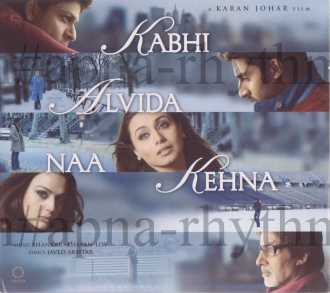
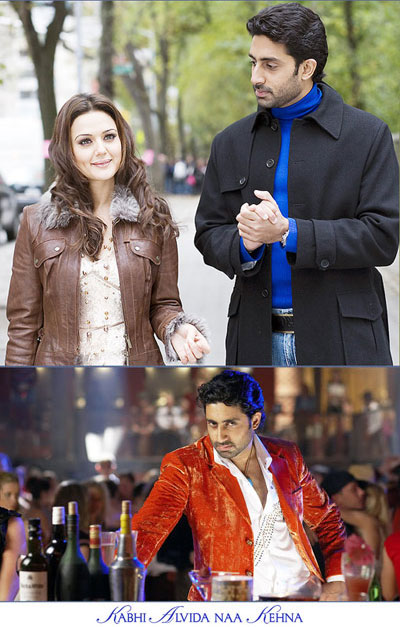
Kabhi Alvida Naa Kehna (Never Say Goodbye)


(image source: http://i.indiafm.com/img/feature/06/aug/kank1.jpg)

KANK is an intense adult drama. It opens with snippets of scenes giving a glimpse of each of the main characters’ lives at the present time, featuring five of Bollywood’s top stars: Ambitah Bachchan, Shah Rukh Khan, Rani Mukherjee, Abhishek Bachchan, and Preity Zinta.

Dev Saran (Shah Rukh Khan) has just won a major soccer match which will garner him offers with great financial opportunities, at the same time, his wife, Rhea (Preity Zinta) has landed a job at a fashion magazine. They are high-powered, ambitious people. They meet in college and married.

Shift to Rishi Talwar (Abhishek Bachchan) who is in a frantic rush to get to his wedding ceremony. Dev’s mother, Kamaljit (Kirron Kher), is the wedding’s caterer. The lives of the two couples intersect when Dev stops by to see her. The wedding ceremony has not begun because the bride is delayed. Dev wanders the house grounds and finds the bride, Maya (Rani Mukherjee), sitting on a bench. It is clear she is having doubts about getting married.

Dev tries to lighten her mood. He asks if she loves her future husband. She says they have been friends since childhood. He asks her again, “Do you love him?” “When there is friendship, there is little room for love”, is her response. Dev suggests she learn to make do with little love stories.

Maya asks him, “Do you love your wife?” He replies, “We are happy.” Maya wants to know, “Do you wait for love?” After more discussion, Dev says, “Goodbye.” Maya stops him, “Don’t say goodbye, it kills the hope of meeting again.” They part and both look back with wonder. Sadly, Dev is distracted by their conversation and fails to see a oncoming car.

The movie picks up again four years later and Dev is a changed man. His injuries from the car accident terminated his sports career. He is angry and bitter. He is rude to strangers and his family. To avoid conflict, Rhea focuses on her job with “Diva”, the fashion magazine. Dev coaches his son's, Arjun (Arjun Rampal), soccer team but he is impatient and harsh with the children. Dev feels his reduced state acutely not just because he can no longer play sports but also because his wife supports him.


(image source: http://www.indiatarget.com/stills/slide_show/kak1.jpg)

Maya’s relationship with Rishi is more like mother and son. While Rishi is passionate about his love for Maya, she is in conflict with her feelings. Rishi’s father, Sam (Amitabh Bachchan), a widower, adds color to the story as he pops in and out of everyone’s life with a different young beauty on his arm each time.

Dev and Maya run into each other again and Maya tells him, “If I had not met you, I would not have married.” Dev replies, “If I had not meet you, my life would have been different. We are both wounded.”

Various misunderstandings complicate the story. Both couples have different expectations of each other. No one is a true villain.

In frustration, Dev and Maya become confidants hoping to help each other in their relationships. They begin to meet regularly at the train station. The train station becomes an analogy for their stalled relationships, which are always moving but going nowhere. Gradually, Dev begins to realize he feels different about himself when he was with Maya.

The intensity of Rishi’s frustration, Maya’s disappointment, Dev’s anger, and Rhea’s distraction symbolize their desire for the greatest of all relationships that of husband and wife. Each felt when you married, you married your soulmate.

Another aspect of the relationships is their mismatched ambitions. In the beginning, Dev was as ambitious as his wife but after his injury, he never recovered from the loss of his career. Maya is uncomfortable with Rishi’s fast and flashy lifestyle. Rhea is caught up in her new business venture.

At their best, couples grow as individuals and as a couple with shared interests. At their worst, couples tear each other apart. Both couples recognize their relationships need help and they make attempts to repair them. Each partner in the two relationships illustrate that there are many doors to the heart and not everyone finds the right door.

Eventually, Maya and Dev acknowledge their love for each other as their marriages deteriorate. While Maya and Dev try to sustain both their relationship and their marriages, their spouses are unaware of their partners’ actions. It makes you wonder if anyone knows what is in another’s heart.


(image source: http://i.indiafm.com/img/feature/06/aug/kank1.jpg)

Dev shows the least concern for how his actions will affect others. Maya had hoped for friendship then seemed unable to stop herself from crossing the line into romantic love. Rishi thought flowers and sweet words were all that was needed for a relationship to work. Rhea valued her business success over the success of her marriage.

Dev is often coarse and cruel. He uses his wife to make Maya insecure. Dev also becomes jealous of Rishi. Love has not encouraged Dev to grow emotionally; he becomes more brutal in his relationships.

Once Dev and Maya cross the line into intimacy, they enter the world of betrayal and lies. The pressure of their illicit relationship drives Dev to joke at a family dinner that he has fallen in love with another woman, Maya. Dev then treats Maya cruelly when he says he won’t leave his wife.

But what is also reflected in each couple is that they married young and as they changed they grew apart. They also lived in a fast-paced, money-driven society with lots of trappings and distractions. Neither relationship seemed grounded.

Dev and Maya break off their relationship believing if they tell the truth they could save their marriages. When Dev tells his wife he has strayed from the marriage but wants to give the marriage another chance, Rhea throws him out. Rishi confronts Maya and asks her to leave. Dev and Maya pretend to each other that their spouses will forgive them. Yet, each leaves for different jobs in different towns.

Observations: Do not tell me Shah Rukh Khan cannot act. SRK played the Dev character so convincingly; I forgot he was Shah Rukh Khan. Also, there are many “inside” references, humorous moments, and guest appearances.

Pleasures: Karan Johar handled the difficult scenes with taste.

Disappointments: Karan Johar has made a Bollywood film with little reference to India or the Hindu religion. The story seemed to lack an anchor or a cultural context, almost as if the setting, New York City, was a culture unto itself and sufficient for a cultural foundation. I found the culture empty, devoid of any fundamental beliefs or moral guidance. Also, while the song and dance routines offer some light moments in this intense drama, the huge disco scenes were impersonal, and lacked the crisp coordination and stylized look that make dance numbers special.

3:25 minutes, Hindi with English captions, Color
Writer and Director: Karan Johar
Producer: Anadil Hossain
Music: Shankar Madadevan, Loy Mendonsa and Ehsaan Noorani
Cinematography: Anil Mehta
Art Direction: Sharmishta Roy
Choreography: Farah Khan
(source: http://www.imdb.com/title/tt0449999/)

Friday, July 14, 2006

Krrish

2006; Hindi with English subtitles; 154 minutes


(source: http://www.chinapress.com.my/data%5C2006-07-02%5Centertainment%5C0702pen91.jpg)


I was looking forward to Krrish because I hoped it would showcase Hrithik Roshan’s skills as a dancer and his physical prowess. Krrish does illustrate Hrithik’s admirable physique, and his grace and agility in cinematographically beautiful settings that include a variety of delightful special effects. But, except for the introduction of Hrithik’s character, Krishna, the storyline flounders and few of the secondary characters are adequately developed to elicit sympathy.

I have always defended Bollywood filmmakers when they made a story similar to a Hollywood story because I felt they kept the universals of the story and made the characters, settings, and conflicts sufficiently different. Sadly, with Krrish, it was like watching a compilation of several movies. In Tarzan-like fashion, Krishna meets in his love interest in the forest. A ghost story gimmick seems to mimic the Blair Witch Project. The bad guy, Dr. Arya, wants to invent a computer that can see into the future, much like Paycheck, and who had an enormous facility on an island like Dr. No. Then, there were the alien communications like ET and Close Encounters.

I am aware that in many Bollywood movies images, bits of dialogue, snippets of songs and more from other movies are inserted to add entertainment value and pay homage to well-loved movies but I never felt that whole sections of the referenced movies were inserted into the current movie like I did with Krrish.


(source: http://img.indiaglitz.com/hindi/wallpaper/MOVIES/krrish/krrish11_800_080506.jpg)


In Krrish, few of the usual underlying moral premises are stated clearly – familial loyalty is there and occasionally the idea that fighting for a good cause is heroic is stated but for the rest of the movie the characters seem to be sensation-seekers out for money, fame, or power.

Unfortunately, I have come to a place in my Bollywood film watching where the novelty is wearing off and I have begun to expect more. This is not always good. It is easy to criticize. Movie making is a tough business. I recognize how hard it is for a director to film a story for far-flung audiences with wide-ranging, changing expectations.

Krrish is a sequel to Koi…Mil Gaya and the previous story is woven into the present story. Krishna is the son of Rohit, a man who encountered an alien and was changed physically and mentally. But, at Krishna’s birth, disaster struck and he lost his parents. Krishna’s grandmother has taken him into the countryside to keep him from public view for fear of his safety. As the child grows, he exhibits extraordinary powers but while he enjoys using them, his grandmother continues to warn him about appearing different.

Priya, Krishna’s love interest, played by Priyanka Chopra, is portrayed as a vain, stupid girl who lacks integrity. She is not an intrepid reporter like Sridevi’s Seema Sohni in Mr. India. Nor does she have the backbone of Manisha Koirala’s Meghan in Dil Se. There is little drama in various obstacles to Krrish’s love for Pryia which I missed because Pryia’s character never developed beyond a pretty girl more worried about her clothes than any conflicting values in her life. Again, it is easy to criticize – few women can handle the stunts required for Bollywood movies, but I wanted to see something like Rani’s zest, she throws herself into her roles, while she is beautiful, she is more physically comfortable with wild and wacky stunts. I missed Madhuri’s wide range of emotional expressions. I missed Kajol’s joie de vivre. I missed Nagris’s melodrama. Chopra is more like eye candy for males. It was hard for me to maintain interest in the story when Priya kept getting Krishna into trouble with her lies.

The bright spots were when Hrithik was on screen. Hrithik appeared to enjoy doing the various stunts. He is a gorgeous human being. He has an abundance of grace and style. I will never get tired of watching him move. He is a splendid dancer and a great martial arts student. I hope Hrithik finds a character or theme where he can continue to demonstrate the beauty of his well-kept physique. On top of all that – he a good person and it comes across on screen much like Shah Rukh Khan.


(source: http://img.stopklatka.pl/wydarzenia/32000/32000/32089-01.jpg)

While the ending was sappy, it was still tearful. While the Krrish character was original, the story was not.

Regrets: Missed the full-blown emotional tug-of-war and the lack of originality in the story.

Pleasures: Watching Hrithik dance and do martial arts stunts; the countryside scenery and the scenes shot in Singapore. Also, the circus scenes were fantastic and seemed to stand out from the rest of the movie.

Credits:
(Source: http://www.imdb.com/title/tt0432637/)

Director and Producer: Rakesh Roshan

Writing credits: Screenplay -- Robin Bhatt, Sachin Bhowmick, Honey Irani, Akash Khurana, and Rakesh Roshan; Dialogue -- Sanjay Masoom

Cast: Rekha, Hrithik Roshan, Priyanka Chopra, Sharat Saxena, Puneet Issar, Hemant Pandey, Manini De, Naseeruddin Shah, Preity Zinta, Kiran Juneja, Archana Puran Singh

Music: Salim Merchant, Suleman Merchant, Rajesh Roshan

Cinematography: Piyush Shah, Santosh Thundiiayil

Art Direction: Samir Chanda

Visual Effects: Marc Kolbe, Craig A. Mumma

Stunts: Siu-Tung Ching (choreographer and stunts), Shyam Kaushal (stunt coordinator)

Saturday, June 03, 2006

Kajol is Back in Fanaa

I caught Fanaa, opening night, and it was a full house.

How does one write a movie review without giving away the plot?

In Fanaa, Kajol plays Zooni, a young blind girl on her first venture away from her home in Kashmir. In the story, Zooni’s blindness illustrates that sometimes we see things with our hearts but we are blind to dangers and deceit, and with sight sometimes we do not see the real person in front of us.

Zooni travels with a troupe of dancers to Delhi to perform in part of the Independence Day celebrations. Included in the trip are several days of tours of the historic sites in Delhi. The group has arranged for a bus and a guide. The guide is a charming rouge, Rehan, played by Aamir Khan. Khan plays Rehan with both charm and cruelty. He admits openly he only wants to satisfy his own desires and that he does not believe in love as he flirts with the girls. But he falls in love with Zooni and she falls in love with him. Rehan is every young girl’s parents’ nightmare.

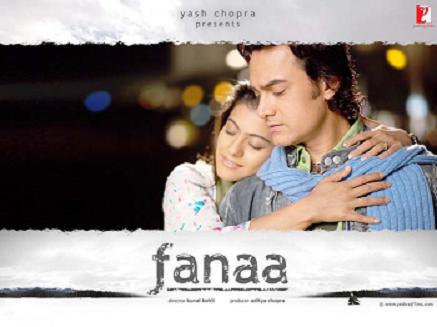
(image source: http://www.ndtv.com/images/topstories/fanaa.jpg)

A Bollywood movie doesn’t cut to the chase as quickly as a Hollywood film. Various aspects of the characters and sub-plots are given time to develop before the central conflict is unfolded.

The cinematography is stunning. It is as if the cameraman is in love with India. Delhi is shown in a rainbow of colors, shining and majestic. Yet, Rehan shows Zooni the dark side of Delhi’s history, too. Kashmir is pictured like a winter wonderland with endless vistas of beautiful snow capped mountains. The camera captured the silence and wonder of snow.

Director Kunal Kohli blends many of the musical interludes with the story almost seamlessly. There is one musical number choreographed with a large number of dancers, the rest of the musical interludes lets the music simply touch the characters as the story moves forward which I think represents Indians’ love of music and poetry as part of their daily lives. Later in the movie, the fantasy love scenes are shot in wonderful blue and white settings and each love scene is done tastefully.

Interwoven into this love story is the continuing story of terrorism. This time it is the battle over Kashmir. Zooni loses Rehan to terrorism before she returns home to Kashmir.

At the interlude, the story changes from a love story to suspense. India’s counter-terrorism organization is tracking a terrorist group that has had success over the years in bombing various important cultural and political sites. Tabu is dead-on as the organization’s agent who works to build a psychological profile of the group’s mastermind even as agents within the organization seek to thwart her efforts. The organization seeks to capture this mastermind before the terrorist group’s final plan is carried out. The plan threatens to kill millions of Indians. The premise the terrorist group uses in its defense is if we are sufficiently armed and are perceived as a threat of massive proportion then we can affect the balance of power and achieve our goal – independence for Kashmir. Isn’t that the premise behind every nation that has nuclear weapons?

At the heart of many Bollywood movies are human relationships and the importance of family.

Zooni is a meaty role for Kajol and she carries it off beautifully. As a young blind girl, Zooni is gentle, loving and hopeful. Later in the film, Zooni is a single mother. She is older, wiser, and she is fiercely protective of her family. Aamir Khan’s character, Rehan, is a man torn between loyalties and desires. At first, he is seen as a self-centered charmer who preys on young women. He has cut himself off from his emotions. Then he falls in love with Zooni and he battles his emotions in a struggle over his loyalties. Is he loyal to his love for Zooni, or is he loyal to his former life? Khan’s character believes that loyalty to a belief carries more weight than loyalty to love, even familial love.


I know little about Aamir Khan’s earlier movies, but in his recent movies such as Laagan, Mangal Pandey, Rang de Basanti, and now Fanaa, it seems that Khan is selecting stories that portray a gritty realism. In these films, Khan is carving out a particular type of role for himself. He does not want to be the lover; he wants to be a man of action. Yet, when he must play the lover, he does so reluctantly. He struggles with the emotion of love, literally fighting himself to keep from falling in love. When he is a man of action, he wants to be rational, unaffected by emotion, and loyal to his vision. But loyalty can also be a strong emotion. Khan wants to play to a male audience who feels it is manlier to be pragmatic than to a female audience who feels love is central to life. Yet, when his character, Rehan, feels he must choose love or loyalty, the war between his competing desires plays across his face. (image source: http://blog.chosun.com/web_file/blog/25/25/1/Fanaa.jpg)

Whereas, as a woman, Kajol’s character’s struggle is not choosing between two strong desires. For her, love is part of life, just as is loyalty. She thought love could heal, love could change a person, love could make a prince out of a beggar. Her struggle is in loving a flawed human being and learning that love can be shattered by deceit. In a way, Zooni’s character is torn because she is forced to make a choice she never imagined she would have to make.

Pleasures: It is great to have Kajol back on the big screen. Plus, the costumes were fresh and vibrant. The shots of Delhi and the snowy mountain scenes were beautiful.

Regrets: The ending was too similar to the "Key to Rebecca" by Ken Follett.

FYI: Fanaa -- is an Urdu word which means annihilation. In Sufi tradition, it also means destroyed in love. (source: http://www.imdb.com/title/tt0439662/trivia)

Director: Kunal Kohli
Producers: Yash and Aditya Chopra
Executive producer: Sanjay Shivalkar
Music: Jatin Pandit, Lalit Pandit
Cinematography: Ravi K. Chandran
Choreographer: Saroj Khan
Runtime: 168 minutes

Friday, February 24, 2006

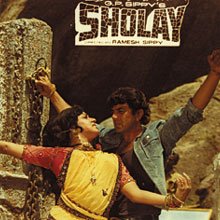
Sholay: A Flash from the Past

Sholay (Flames)

1975; 204 minutes; Hindi with English subtitles

Director: Ramesh Sippy
Producer: G.P. Sippy
Writer: Javed Akhtar, Salim Khan
Music: Rahul Dev Burman
Cinematography: Dwarka Divecha
Playback singers: Rahul Dev Burman, basu Deo chakravarty, Babu Ghanekar; Shankar Lal; Maqbool
Dances: P.R.L. Raman
Cast: Dharmendra, Amitabh Bachchan, Sanjeev Kumar, Hema Malini, Jaya Bhaduri, Amjad Khan, A.K. Hangal, Satyen Kappu, Leela Misra and more


Sholay is considered an Indian movie classic. I enjoyed most of this film, which starts with an eye-popping shoot-out, followed by chase scenes through the backcountry, and canyons of rural India. The cinematography is excellent. The camera work is a blend of styles including fast action, slow motion, and panoramic views. But, eventually, the relentless scenes of violence wore me down.

Many of the performances were enjoyable. I thought Dharmendra (Veeru) was smashing and Amitabh Bachchan’s (Jai) onscreen persona crackles with energy and emotion. Sanjeev Kumar plays the village chief, Thakur Singh, with dignity and Hema Malini’s character, Basanti, bounces with charm.

Dharmendra


In essence, the village chief, Thakur Baldev Singh, a retired police officer, asks a fellow police officer to track down two criminals (Veeru and Jai) he met in the past to ask them to come to his village and help him end the tyranny of a local thug, Gabbar Singh (Amjad Khan) because he thinks they are brave and have the potential to be decent human beings. When the police officer questions his judgment saying, “A fake coin is a fake coin.” He replies, “a man is not a coin.”

The criminals, Jai and Veeru, have been a team for sometime and travel from con to theft to scam as they escape just ahead of capture, most of the time.

What starts out as a buddy flick becomes a civil war between Thakur Baldev Singh, Veeru and Jai, and Gabbar Singh’s gang of thugs.


Many other characters intervene in the story like S. Bhoplai, the greedy shopkeeper; the inept prison warden, a Hitler look-alike, who states he doesn’t believe in reform because “How can you change, if I can’t change?”; Hariram, the jail barber and squealer; and the chatty buggy driver, Basanti (Hema Malini).

Gabbar Singh, the thug who terrorizes the village, is a piece of work. He plays Russian roulette with his men when they run from the village under gunfire. While at first, none of the men are shot, you know what’s coming.

Thugs attack the village and the village protectors retaliate, back and forth, with one horror after another. When the thugs break up the village Holi celebration, it’s like a shoot-out at the OK Corral.

Thakur and Gabbar have a long history. Gabbar killed Thakur’s brother’s family as revenge for Thakur imprisoning him.

Scenes of normal events of life break the flow of constant conflict. Veeru has fallen in love with Basanti. Jai goes to Basanti’s Aunt to plead Veeru’s case. Instead, he paints a poor picture of his friend’s lifestyle scuttling Veeru’s chances to marry Basanti. But, that’s not the end of this substory.

Veeru wants to settle down. Jai isn’t ready though he shows a quiet interest in Thakur’s widowed daughter-in-law, Radha (Jaya Bhaduri).

In one raid, Gabbar kidnaps Basanti. Veeru follows and is captured. Gabbar forces Basanti to dance to save him. When Basanti dances, she endures many humiliations and agonies showing her strength of will much like a fight scene does for the hero.


So much horror and tragedy is perpetrated by Gabbar, I wanted to shoot him myself just to end the relentless torture.

At one point, the villagers have had enough of the violence, too, and question whether all the killings are worth the refusal to give Gabbar the protection payment. One man says, “We are farmers not soldiers.” Another replies, “To lead an honorable life, there is a price.” When an elderly and blind villager loses his son to the violence, he refuses to give in to Gabbar’s violence and threats saying, “An honorable death is better than a life of humiliation.”

The ending is a mixture of sorrow and survival.

Saturday, February 11, 2006

Chocolate is not Sweet

WARNING: this movie shows scenes of gang rape, group sex, prostitution, and gratuitous violence as pleasurable and desirable activities.

Most offensive scene: a glimpse of a gang rape was subliminally slipped into one of the pornographic song and dance routines. This is mind rape not “entertainment.”

Some Bollywood critics complain their movies need to be more realistic, more “westernized” to be accepted internationally. If this film is an example of a “westernized” Bollywood film, then the soul of Bollywood has been lost.

This is a gangster movie produced by those who want to see the criminal lifestyle glamorized and to make money off portraying titillating acts of violence, murder, robbery, pornography, and prostitution geared toward a youthful male audience.

This is not a family movie.

The theme of this movie is “money is power and with power you can do anything you want.”

The story of how two members of a London musical group came to be arrested for murder and robbery is not a story about good versus evil. It is just a story of evil.

The acting is sullen and unimaginative. None of the characters are sympathetic. I never cared what happened to them. They were middle-class, self-absorbed petty criminals.

The song and dance scenes are pornographic and inconsequential. Visual pornography, in my mind, is when scenes of gang rape, group sex, or other sexually twisted behaviors are shown in their entirety as if to fill the minds of the audience because they lack an imagination. Pornography is meant to make those who feel powerless in life, to feel powerful momentarily. Pornography usually shows one or more persons in a “dominant” position, a position with the power over the life of a “submissive” person. Pornography usually shows the “submissive” person performing degrading acts of sex or violence or having degrading acts of sex or violence performed upon them. Pornography is joyless and humorless.

The person, who participates in pornographic acts of gang rape, group sex, or other sexually twisted or violent behaviors because they think it is cool, do not realize they have sold their soul in the process.

In addition, pornography, which can be visual or verbal, is made to stimulate a primitive part brain that responses, psychologically and physically, to violent or sexual stimuli, in attempt to encourage people to enjoy this type of behavior, to give them a momentary sense of power, and to numb them to the consequences of this behavior so that they begin to accept this behavior as “normal.”

Ask yourself – who controls your mind?

Regret: I am sorry Anil Kapoor lent his name to this film. He plays a London lawyer attempting to help the two arrested Indian musicians.. Anil’s character, Krish, seemed laden with accoutrements like he was drowning in an excess of material goods and self-advertisement.


(image source: http://www.bollyfm.com/chocolate_cover.jpg )

Producer: Spice Entertainment
Director: Vivek Agnihotri
Starring: Irrfan Khan, Anil Kapoor, Arshad Warsi, Suniel Shetty, Emraan Hashmi, Tanushree Dutta and Sushma Reddy.
Music:Pritam
Lyrics: Mayur Puri, Praveen Bhardwaj, Dev Kohli, Ajeet Srivastava

Tuesday, February 07, 2006

Film Festivals and Bollywood

One way to show your enthusiasm and support for Bollywood films is to attend a film festival showing Bollywood films, especially new ones.

The link above is just one of many that lists a variety of film festivals.

In Washington, DC, near where I live there are several film festivals --

DCIFF (DC Independent Film Festival)
March 2 - March 12
There are several Indian-based films in the festival.

In Quest for the Spectacular by Aunshuman Apte
About an actor in Mumbai trying to make it in Bollywood.
Sunday, 3/12/2006 2:20pm
Avalon Theatre

Lucky by Kristen Palana
An young Indian American woman faces an arranged marriage while trying to live the American dream.
Friday, 3/10/2006 9:10pm
Jewish Community Center

Ordinary Lives by Sheetal Agarwal
Documents the struggles of a family of ten living in a 180 square feet shack in Mumbai.
Wednesday, 3/8/2006 12:00 pm
Gala Theatre -- Tivoli

Truck of Dreams by Arun Kumar
Parallel stories of Bollywood -- of a truck carrying Bollywood movies to outlying villages and the dreams of a village girl.
Friday, 3/10/2006 9:10pm
Jewish Community Center


DC Film Fest
April 19 - April 30, 2006
In last year's festival, several Indian films were shown such as Raincoat, Dil Se, and Mughal-e-Azam. Films are shown at several area theaters. The website www.filmfestdc.org does not list the 2006 film program yet, so keep watching the site for the listing.

Maryland Film Festival/Baltimore
May 11 - May 14


Silver Docs
June 13 - June 18


Will update post with information as I find it.

Saturday, February 04, 2006

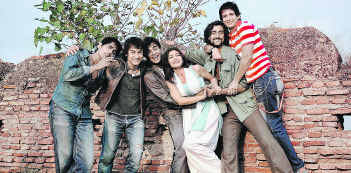
Rang de Basanti

Director: Rakyesh Mehra
Producer: Rakyesh Mehra, Ronnie Screwvala
Cinematography: Binod Pradhan
Music: A.R. Rahman
Lyrics: Prasoon Joshi, Nacim and Blaaze
Screenplay: Rensil Dsilva
Art Direction: Allan Amin
Cast: Aamir Khan, Alice Patten, Madhavan, Soha Ali Khan, Kunal Kapoor, Siddharth, Sharman Joshi, Atul Kulkarmni, Kirron Kher, Waheeda Rehman, Anupam Kher


Quick Take: Historic events of the Indian revolt against British colonialism are set against the backdrop of the lives of present-day college students. The film is beautifully shot. Scenes are fluid and realistic. Music is treated as background more like Muszak than performances. Aamir Khan’s acting is layered, subtle, and superb. He generously shares the screen with the other actri, each of whom portrays their varied characters with energy and believability. The story is a call to idealism with a terrible twist at the end that echoes with images of Tiananmen Square.

Review

The opening prison scene in sepia sets the stage for the blend of past and present as reenactments of British acts of brutal suppression of Indians seeking freedom from their colonial yoke mix with images of rowdy college students filming a documentary of Indian revolutionaries Bhagat Singh, Rajguru, Ashfaqulla Khan, Ram Prasad Bismil, Durga Bhabhi and Chandrashekhar Azad.

The story of a young British woman’s goal of making a documentary of the Indian revolutionaries inspired by her grandfather’s diary wraps around the present day story of the lives of young college students. Her grandfather, Major McKinley, participated in Britain’s attempts to squelch rising protests after World War I by capturing, torturing, and hanging the young revolutionaries. His diary entries foretell the fall of Britain’s rule of India.

After Sue’s (Alice Patten) production company nixes the project she has been working on for two years, she packs up her materials and goes to India to make the documentary on her own. She stays with a friend, Sonia (Soha Ali Khan) on a college campus and begins to audition students for the roles. The auditions are humorous much like “American Idol.” Frustrated she has not found anyone to play the revolutionaries, Sonia, takes Sue to a party to lift her spirits.

Bonfires, beer, music, and pranks entertain the crowd of students at the party. Sonia greets several students and laughs at their antics. DJ (Aamir Khan) is seen with a friend atop a stonewall drinking beer while bending backwards over the river below to see who can drink the most without falling in. As Sue watches, she realizes Sonia’s friends would be perfect for her documentary and enlists Sonia to help persuade them to act in her film. Sue joins in the party as the students dance and gyrate randomly on the beach to western music.

Scenes of fast cars and motorcycles, drinking, and seeking easy sexual favors from girls flash by as the students head toward DJ’s home. There, as the group eats dinner, scenes from the past blend with the present as the story of the revolutionaries continues in flashbacks. Sue implores them to help her saying, “They were heroes. They fought for their country’s freedom.” The students are unimpressed. Later DJ tries to explain to Sue why they seem aimless and why he and the others love college. Their country is over-populated, has major unemployment problems and other seemingly insurmountable problems. In college, we are masters of our destinies. After college, we are at the mercy of fate. At least on campus, I am somebody. But when I get out I will be nameless, faceless, lost in the crowd.”

Gradually, we meet each student. Karan’s father (Anupam Kher), who is rich, greets his son with questions. Has Karan decided which American college he will attend? When Karan (Sidddharth) mutters a few words, his father says in disgust, “Yours is the SMS generation, no conversation beyond four lines.” His father fails to see his son’s confusion and need for a goal beyond making money. A phone call regarding the sale of cheap airplane parts interrupts their interaction.

Laxman’s Muslim family berates him for his associations with non-Muslims saying “This country has never accepted Muslims.” To which Laxman (Atul Kulkarni) replies, “I can not fill myself with hate.”

India’s fight for independence from British Imperialism was harder for their nation than it was for the American colonies. The American colonists had vanquished the native population through murder, disease, and relocation, so they only had the British army to fight. Whereas in India, hundreds of tribes of various religious beliefs had existed for thousands of years, internal conflict among the various groups kept the population from uniting against British rule. But, the young revolutionaries were Hindi, Muslim, and Sikh. They had overcome their differences to fight for a greater cause, the freedom of their country. That Sue, a Britain, has to explain this to the students is ironic. One student remarked, “They would call you nuts today, if you said you wanted to fight for your country.”

Eventually, the students agree to do the documentary and many scenes follow of the rehearsals mixed with youthful outings and pranks. In the face of what they think their world has become, they do not feel they have anything in common with the revolutionaries they portray.

The massacre of hundreds of unarmed people in Jallianwallah Bagh on April 13, 1919, by the British, was the spark that set off the revolution. The event is reflected in horrific reenactment flashbacks. This act of violence turned a non-violent people into revolutionaries.

Music scenes are shot to blend with the story. Essentially, the students prance to a musical background of youthful songs as they carouse in the city streets.

Up until the interval, the film is replete with humorous asides such as when the students are leaving a movie theater and they explain to Sue, “That’s why India grows trees so we can dance around them.”

While roaming the countryside, Sonia’s boyfriend, Ajay, an Air Force pilot, asks her to marry him.


(Image source: http://www.hindu.com/2006/01/29/images/2006012904760201.jpg)

After the interval, the students watch the documentary they made. They are sobered by it. But quickly fall back to their previous perspective, “There’s nothing worth giving your life for. When we leave college, we will have to fight just for the basics. Corruption is in our DNA.” They believe it does not matter what you do, nothing will change.

Then, they see the news their friend Ajay (Madhavan), the Air Force pilot, has died in a plane crash. At first, there is speculation that the plane malfunctioned due to the purchase of cheap defective replacement parts. But, as public demands for an inquiry increase, government officials begin to denigrate the dead pilot’s reputation to place the blame on him.

His friends and family retaliate by holding a candlelight vigil to protest the defamation of his reputation and to support the investigation of corruption. The parts dealer, Karan’s father, reassures the Minster of Defence, “Public memory is short.”

When the vigil continues to bring pressure on the government, riot troops are called in and the crowd is beaten into submission. Ajay’s mother (Waheena Rehman) is beaten into a coma. This is how the Indian government answers its public.

When Laxman, is beaten up by his own family with his father’s consent for his acceptance of others, I knew how he felt.

The tenor of the film changed. The group of friends becomes comrade-in-arms as they plan their revenge against a corrupt and unresponsive government. One student notes, “The Defence Minster is suppose to safeguard the nation not sell it.”

Pleasures: I appreciated the modern look of the sets and cinematography. In addition, this is a great ensemble film shorn of excessive sentimentaility. Plus, I am a sucker for handsome men like Madhavan. His part may have been brief but he graced the screen with charm and electric good looks.

Regrets: I missed the full-blown song-and-dance routines but I understood what the director was trying to do with the music. My disappointment is that the solution the film offers seems as empty as the corruption it was meant to rectify.

Commentary

While I understand this film is a call to idealism, I could not see how the ending would achieve that result. This film has many scenes of violence. While they may have been “tastefully done” there were still too many for me. I have strong feelings about the use of violence. I want to believe people can find more diplomatic ways to resolve their differences.

What did the director hope the response would be to his film? Does he think young people will take to the streets and begin killing anyone they decide is corrupt?

Tuesday, January 24, 2006

Bluffmaster

Director: Rohan Sippy
Producer: Ramesh Sippy
Screenplay: Shridhar Raghavan
Dialogue: Rajat Arora
Music by: Arash, Vishal Dadlani, Sameeruddinand Shekhar Raviiani
Cinematography: Himman Dhamija
Cast: Abhishek Bachchan, Priyanka Chopra, Ritesh Deshmukh, Boman Irani, Nana Patekar

This film is a comedy buried in a light soul-searching drama. You could also say it’s a male-bonding version of "Bunty Aur Babli" without its charm and style. While the film was enjoyable, Abhishek looked tired. I wondered if he was juggling too many films while shooting this one.

Bluffmaster opens with an elaborate scam introducing Roy Kapoor (Abhishek Bachchan), a major con artist, proving if it sounds too good to be true, it probably is. But things quickly fall apart. At Roy’s engagement party, a guest, the recently scammed gentleman, informs Simmi Khanna (Priyanka Chopra), Roy's fiancee, and her parents about the source of Roy’s income. Simmi promptly dumps Roy.

As Roy ponders his future, enter Dittu, a conman in training. Dittu seeks to learn from a master, so he strikes up a friendship with Roy in an unusual way. A series of scams follow mixed with occasional encounters with Simmi where Roy attempts to win her back. While some of the scams seemed pulled from other films, the door-to-door salesman scam is a kick. But somewhere in the mix you wonder who is being scammed? Riteish Deshmukh as Dittu brightens the screen as a cheeky young man with a delightful collection of T-shirts.

Roy takes Dittu under his wing outlining the rules of the con game while at the same time trying to dissuade him from becoming a con artist. Roy tells Dittu, “I choose the wrong road.”

Then Roy begins to have fainting spells. Enter zany Dr. Bhalerao (Boman Irani) who tells Roy he only has three months to live. One piece of advice Dr. Bhalerao gives Roy is “Life tastes sweetest when death is at your door.” Then things really get mixed up.


(Image source: http://www.lexpress.mu/)

In a final scam Roy seeks to save Simmi from a predatory hotel owner (Nana Patekar) and the outcome is unexpected.

Dropped into the fast-paced dialogue are funny references to Bollywood and Hollywood films the audience enjoyed.

Another enjoyable feature was the cinematography especially the panoramic shots of various Mumbai cityscapes.

One regret is most of the music scenes were chaotic. Disco dancing lacks the ability to show off a performer’s dancing skills and I know Abhishek can dance.

I think I will begin to put a “U” label in my reviews. This was another macho flick with the requisite meeting in the bathroom at the urinals. Do women have a common meeting place in films?

Friday, November 25, 2005

Garam Masala

Director: Priyadarshan
Screenplay: Neeraj Vora
Cinematography: Tirru
Choreography: Pony Verma
Art: Sabu Cyril


Garam Masala is a farce, a comedy built upon absurd situations. Full of humor, slapstick, and swarms of beautiful women, Garam Masala is good for laughs.

Akshay Kumar and John Abraham play two bumbling photographers, Makrand and Shyam, who shoot pictures of beautiful women for their employer at the magazine, Garam Masala but fail to produce pictures suitable for print.

Mak and Shyam use their occupation as a way to meet and bed as many women as they can, tripping over themselves in the process. They tell so many lies to get what they want, they cannot keep track of their stories. When Shyam wins an international photography contest by fraudulent means, he becomes Mak’s boss. Mak becomes jealous and they part company.

To replace his means of impressing women, Mak lands a job as caretaker of a beautiful home. Many friends are willing to help Mak succeed in setting up an attractive trap to lure beautiful women. One friend, a mechanic, supplies him with expensive cars. Another friend introduces Mak to three airline hostesses Sweety, Puja, and Deepti played by Neetu Chandra, Nargis Bagheri, and Daisy Bopana.

Mak immediately promises undying love to all three and maintains a schedule so the women do not meet. At least, that is his plan.

To complicate matters, Mak ignores the fact he is engaged. Besides balancing the schedules of the airline hostesses, he must also placate a neglected fiancée, Anjali, played by Rimi Sen.

Mak’s cook, Mambo, played by Paresh Rawal, is the funniest character in the movie. Hired by Mak after stating outrageous demands, Mambo reluctantly helps Mak in his deceptions. He rebels every time one of Mak’s female guests demands a certain dish and by the time he has prepared the dish, a new girl has been ushered in through a host of revolving doors and is offended by Mambo’s cooking. He throws out the food and packs his bags.

When Shyam returns, he bribes Babbar, the mechanic, played by Rajpal Yadav, with the promise of liquor and money to get Mak’s new address. Once at Mak’s, Shyam gives him two rupees. Babbar turns his nose up and stuffs the bills back in Shyam’s shirt pocket along with a contribution of his own.

Shyam joins in Mak’s games. Changes in flight schedules have the trio, Mak, Shyam, and Mambo running in circles and falling all over themselves fabricating story after story to divert the various women. When Anjali pops up now and again, she adds to the trio’s mounting confusion. Eventually, Mak’s fantasy life topples as the various girlfriends and fiancée collide.

I love the versatility of Bollywood actri. Many try drama, comedy, romance, adventure and more. Akshay Kumar is an agile, talented, attractive man with a high wattage smile. He dances, jumps, stumbles, rolls, crawls, falls, and runs with ease as his character’s schemes unravel. John Abraham stirred faint memories of Johnny Walker as Akshay’s sidekick. One additional note, the song and dance numbers featured beautiful stylish sets.

Tuesday, November 15, 2005

SRK Quits

SRK Quit Smoking.

While this blog is not a SRK news blog, it is wonderful to hear that SRK has chosen to quit smoking not only because he is a role model for both his fans and his children but also for his own health.

I wish him congratulations and the best of luck in beating the nicotine habit.

Thursday, October 27, 2005

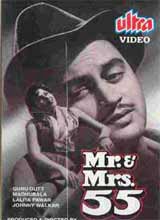
Mr. and Mrs. 55

Now I get it.

This film is both a social commentary and a comedy. The opening scenes sets the stage for "Women's Liberation" versus "love and marriage." An unemployed cartoonist, Pritam (Guru Dutt), has an accidental meeting with a lovestruck, well-to-do girl and becomes infatuated. The girl, Anita (Madhabala), lives with her aunt, Seeta Devi (Lalita Pawar), who is a women's suffragette.

Anita's grandfather has died and left Anita his estate on the condition she marry. Because the aunt wishes Anita to have freedom from the ills of marriage, she seeks a groom willing to marry her niece on the conditions that he not see her after the marriage and that he divorce her soon after.

Pritam accepts the job offer without knowing the details. Once he learns the details, he refuses to be bought but when he finds out the girl he was to marry is Anita, he changes his mind and accepts the offer.

One of the funniest moments in the dialouge is when the aunt, who visits Pritam's humble abode, a rented room, asks, "Are you a communist" and Pritam replies, "No, a cartoonist." Pritam is a man content to live a simple life as long as he is free to live with dignity. He is not interested in material goods.

Meanwhile, Pritam and Anita meet on several occasions before the marriage. Anita is unaware Pritam is her intended groom. Affection grows between them. Early interactions between Pritam and Anita reflect a playful subtext regarding the battle of the sexes.


Anita does not find out Pritam is her future husband until they enter the Judge's chambers. After the civil ceremony, she turns her back on Pritam and refuses to speak to him because she feels he deceived her and is a greedy person.

Soon after Anita and Pritam marry, he gets a job. Unbeknownst to Anita, Pritam has not cashed any of the checks he received in payment for marrying her.

Soon the aunt demands that Pritam divorce Anita. Instead he "kidnaps" her and takes her on a long trip back to his family and his village. Along the way, he continues to try and charm Anita to convince her of his love.

Pritam acts the gentleman and Anita observes his family. In conversation with his sister-in-law, she sees a different side to marriage. The wife expresses a great sense of joy and cheerful duty in caring for her home, husband, and children. My only objection to the sentiments expressed was when Anita asks her if her husband beats her, the wife does not answer directly but says her husband gets angry if he finds his rice has not been perfectly cooked. To include occasional abuse as part of a "happy marriage" is inappropriate.

Anita has grown fond of Pritam but can not sort out her feelings because so many have manipulated the relationship. Her aunt comes to Pritam's village to retrieve Anita. In a burst of frustration with Pritam, Anita returns to her aunt's home. Pritam accepts his fate and stages a photographic session to make it appear he has engaged in dishonorable behaviors so Anita can get a divorce easily. He takes the photographs and the uncashed checks to the aunt. This is where the aunt shows her true colors. Rather than recognize that Pritam has committed a selfless act of love and that he is an honorable person, she pressures Anita to divorce Pritam using the photograph as evidence but does not tell her the source of the photograph or that Pritam returned the checks. Soon Anita learns from Pritam's friend that he staged the photograph and returned the checks.

Anita confronts her aunt with the truth -- and tells her to "go and gain real life experiences rather than giving lectures," because maybe many women are happy in their marriages.

Anita rushes to find Pritam who has made arrangements to fly to Mumbai. As you can guess, the two meet again and make-up.

While the film exaggerates stereotypical negative views of women's suffrage, men should not be rewarded for bad behavior by forcing women to stay with them. The flip side of "women's suffrage" are examples of men who divorce their wives of longstanding for younger wives. The ability to utilize the legal system to redress or remedy injustice or criminal behavior should be available to all.

Madhabala, Guru Dutt, and Johnny Walker provide fine performances. Madhabala's Anita is a bit pouty but she gives an energetic performance and looks wonderful in a black sari as it blows in the wind as she walks through Pritam's village at night. Guru Dutt, who also directed the film, cuts a fine figure and has a good sense of comedic expression as well as an understated expression of emotion. Johnny Walker as Pritam's sidekick is funny. Other secondary characters like the aunt's secretary and Walker's girlfriend also provide fine performances.

Shot in black and white, Guru Dutt made excellent use of shading. At times, the intense contrast added to the mood of various scenes.

Starring: Guru Dutt, Madhubala, Lalita Pawar, Johnny Walker, Yasmin, Kumkum
Screenplay and Dialogues: Abrar Alvi
Cinematography: V.K. Murthy
Lyrics: Majrooh Sultanpuri
Music: O.P. Nayyar
Produced and Directed by: Guru Dutt, 1955

Saturday, October 22, 2005

What I learned from Shah Rukh Khan


In early 2002, after buying a VCR, I began purchasing films. As my film library grew, I decided to broaden my horizons and check the foreign film selections. Among the first foreign films I bought was an Indian film called Asoka.

My previous experience with Indian films was Gandhi. After Asoka’s closing credits rolled down the screen, I was transfixed. Indian films were different from western films. They were three hours long with song and dance routines dispersed throughout. Female actresses looked like real women not like the skinny twenty-year-olds in western films. Men expressed emotions, and multiple generations were represented. Though the dialogue was Hindi, the stories and body language were universal.

I wanted to know more, so I entered the male star’s name, Shah Rukh Khan, into Google and it came up with over a million hits.

It didn’t take long to realize Shah Rukh Khan was a major Bollywood star. To learn more I read about Khan’s life and career. I also immersed myself in his films I got from a local Indian video store.

Some of the best parts of Indian movies, for me, are the song and dance routines, the women’s saris and jewelry, and the doti of the men. I love the energy and style of the dancing, especially the choreography of Farah Khan and Pandit Birju Maharaj. Every woman, no matter her age or shape, looks great in a sari and the men look regal.

Because of many changes in my life during this time, I was grateful to escape into the world of Indian film because it wasn’t here. I could lose myself in another world. I bought a sari and Indian jewelry. I learned a few words in Hindi, drank chai tea, ate Indian food, followed Indian news, and got an India travel guide.

Often when watching Indian movies, you are watching both the story on the screen and also the story of a changing culture. I struggled with the concept of understanding India through its films when I asked myself, “Did western films really reflect the history and culture of my world?” I didn’t think so. But, for the moment, Indian films were all I had.

India’s history is thousands of years old (2500 BC). With a population over one billion, with hundreds of different nationalities and religions, conflict was common.

As I followed Indian news, I watched the nation struggle with cultural conflicts, religious and political, that were often violent. In fact, during the height of my obsession, I had hoped to make a short trip to Mumbai but when the Victorian train station in Mumbai was bombed, I changed my mind. I continue to follow the news in all 29 states and 6 territories of India as they struggle with political unrest, varying economic conditions, corruption, poverty, and the struggle over the sovereignty of Kashmir. India claimed independence from British rule in 1948 after many bitter struggles and the establishment of a Muslim nation, Pakistan and Bangladesh. Kashmir remains, today, a disputed territory.

Indian films reflect these issues and more. In Indian films, you get drama, humor, tragedy, suspense, and celebration.

On screen emotional struggles are often raw and awkward in contrast to the slick dialogue of western movies. In Indian movies, characters are portrayed in exaggerated terms leaving no doubt who is good or evil.

One common conflict in Indian films is forbidden love. Arranged marriages are part of India’s culture but India’s youth are pushing for finding their own love matches, so Indian films reflect this cultural schism.

Another underlying motif of modern Indian films is the historical territorial power struggle of powerful Rajas transferred to political families, large corporations, or corrupt gangs.

Scandals in 2003 about mafia influence in the Indian film industry exposed the corruption that Indian society has not brought under control.

The Indian film industry produces over 800 films a year. It is the biggest film industry in the world.

By the time, I watched Asoka, Khan had become a producer as well as actor. He had been married for over 10 years and had two children.

As I continued to watch Khan’s films and other Indian films, read film reviews and interviews, I came to admire Shah Rukh Khan. His personality shone through in all of his characters. He is a good person. He is generous and passionate. He is energetic, expressive, funny, and attractive.

His philosophy about acting is focused on his audience: “I was here to ask for love. I was here to woo them not impress them. I was here to make them realize I was just one of them, like them, except that my job puts me in different situations and stories. And if I was able to hold up this mirror to everyone I was sure my audience would appreciate me because they would reciprocate their love to one of their own….”

Khan was accessible. He was open and honest in his interviews. He was also humble and some say arrogant. He handled his rise to stardom well. He never lost his sense of himself. He gives god credit for his success. He puts his family and friends first. He is loyal to those who supported him in his career. He took risks. He had become phenomena as one of the most widely recognized and admired stars in India, Asia, and Britain.

Because I found his life’s story interesting, I wanted to understand how he made some of the major decisions in his life. How did he decide to become a film actor? Where did he meet his wife? How did he handle success? How did he handle conflict? How did he choose his films? What were his future plans?

All my questions made me wonder about the concept of a role model. Who were my role models? Should film stars be considered role models? How does one feel about this additional life-long role assigned to them?

Khan has great praise for his parents. His parents were his role models. His mother, Fatima, was an Oxford-educated magistrate. His father, Mir Taj Mohammed, was a freedom fighter and a sensitive, intelligent man. They encouraged him and expected him to do well, but did not put many restrictions on him. His father had started several businesses but was not a great businessman. His family’s economics fluctuated but Shah Rukh Khan never felt deprived.

Khan was intelligent and had determination. When faced with getting a zero in learning Hindi in grade school, he studied late into the night until he got tens.

In college, he majored in mass communication and enjoyed advertising art. He also excelled in sports and wanted to pursue a professional sports career. But, an injury changed those plans. “One cannot be sure of one’s best efforts…. as sometimes your best is just not good enough. And that is one truth I live by even today. One should not get disappointed but try hard next time.” A friend suggested he try television. Khan always turns a negative experience into a positive one.

He loved his parents but lost them early in his life, his father at 15, his mother in his early 20s. He openly grieves their loss in most interviews. “Mother taught me that nothing is permanent…. So enjoy what you have this moment, for it can be taken away from you the next. Everything is transient.”

At 19, he fell in love with Gauri Chibber, a Hindu girl. Khan is Muslim. They dated in secrecy because mixed marriages in India are frowned upon. His future wife’s family disapproved of their engagement, so much so his fiancé’s mother went on a hunger strike. Alternating crowds stood outside his home in Delhi to protest their marriage. Hindus came in the morning, Muslims in the evening.

Undeterred, Khan eventually charmed Gauri’s whole family. On their wedding day, he eagerly participated in the Hindu wedding ceremony, which has many rituals. Khan wanted to know the meaning of each one. As he and Gauri, prepared to leave, her family wept over losing her. To ease their pain, Khan offered to let her stay and he would just visit frequently.


He is known for professing his love for his wife, Gauri, and their family.

Khan was a good student but for some unknown reason, Khan’s college dean discouraged him from continuing in college. Yet, Khan is philosophical about the detours in his life, he feels "no experience that you have in life can ever be wasted."

He had success in several television series and decided to try film, so Khan, his wife, and sister moved to Mumbai. In India, it is common for extended families live together.

Khan has won many awards and made box office history with the movie, Dilwale Dulhania Le Jayenge (Braveheart Takes a Bride), which ran to packed houses for over five years and is still running today. Khan is practical about his acting talents, he feels he has a limited range of expressions but he says “If you can pull it off, it’s a performance, if not it was just an accident, try and do it again and again till one day you die.”

Khan's philosophy about business and money is "These four principles cover my business philosophy: You should work for it, you should not lose money in any business, you should make enough money so that you are in a position of choice. And finally, if you start a business employing a lot of people, the end result, regardless of whether it made money or not, should be that all those people involved should be happy that they gave it a shot. He also believes one should have a greed for: knowledge, money so that you can have choice, and love.

Shah Rukh Khan loves New York City, and came to promote Asoka in September 2001. He and his family were only a few blocks away on September 11. As Khan notes, “We could see the clouds of dust and smoke that engulfed the sky…. the situation was so surreal.” Khan sat by the window for hours, “the police coming, the smoke rising and everything, it was very shocking.”

This was my first experience with fandom. I had never been so taken with a star or an industry. I began to see the positive side of fandom as well as the negative.

Life often requires us to review our perspectives, our feelings, our attitudes, our values, and our actions. I had become stale and rigid in my routines and my views of the world and life. Shah Rukh Khan became a role model for me because I learned from him some of the qualities about making good choices, and the importance of hard work, determination, humility, gratitude, loyalty, humor, love, and joy.

In March 2003, I learned Khan was going to have surgery to correct a longstanding back injury. I, along with millions of others, sent him get-well wishes.

Caring about someone even from afar made a difference in my life.

###

Friday, September 30, 2005

Paheli and the Oscars

Everyone has an opinion about the choice of "Paheli" for India's Oscar submission. Some feel other films should have been chosen for various reasons. Others agree with the choice.

For me, as long as the discussion remains on the various aspects of filmmaking, I think it's good to talk about how films are chosen for awards.

I appreciated "Paheli" for many reasons. I liked the idea of recreating a folk tale of a far-fetched idea of a ghost falling in love with a woman. I also recognized that folk tales can also relay wisdom and insight, or serve as cautionary tales. Folk tales hold universal appeal for all audiences.

"Black" and "Mangal Pandey -- The Rising" were among those considered for Oscar submission. Whlle, "Black" is an incredible film -- beautifully crafted and portrayed, the Helen Keller story is well-known and that is one reason why I think it was not chosen.

"“Mangal Pandey -- The Rising"-- is also a well-crafted film and while the idea of seeking independence and overthrowing suppressors has universal appeal, it is an adult theme. Plus, its theme is similar to Lagaan, a recent Oscar winner.

"Paheli" is many things. It is well-crafted and portrayed. It is also colorful, funny, gentle, sweet, sad, and surprising.


I stopped watching Western films many years ago for many reasons. The stories seemed silly or violent for the sake of violence. Every other movie seemed to be about some freak terrorizing teens, or it would be another shoot-em up, car chase, sex for the sake of sex movie.

I walked out of "Monsters Ball" which won several academy awards. I also walked out of "The Green Mile." Both movies seemed emotionally dead and violent for the sake of violence to me. Many fine Western movies have not been nominated for an Oscar, an example is "Frequency" (2000), a successful, well-crafted movie. I understand the reason for awards but just because a movie is nominated or is not nominated does not necessarily mean it is a good or bad movie.

What I seek to take away from any discussion on film-making is a greater appreciation for the craft of making a film in all its various aspects. Plus, I gain a wider perspective of the world when others share their views.

I have noticed one thing since I began reviewing Bollywood films and this observation holds true for all filmmaking. There seems to be two mindsets for how a story should be portrayed. One perspective is what I call "hard-core realism" -- people in this category seem to view the world as a harsh, cold, survival-of-the-fittest place where you have to watch your back and you have to acquire more "stuff" to survive. The other perspective is what I call "Optimistic" -- people in this category seem to view the world as a friendly, hopeful place, where cooperation among family, friends, co-workers, and strangers are the basis for a healthy civilization. Both views are real.

Sunday, September 18, 2005

Quick Take: Mr. India, Mr. & Mrs. 55, The Hits of Udit Narayan, Bollywood All Time Hits V2, Yours Forever--SRK, Main Hoon Na companion DVD disk

Mr. India -- I can see why this film was so popular. It's intrepid girl reporter tracks crime stories; It's megalomaniac wants to destroy the world with high tech weapons; It's mad professor discovers great invention that could be misused by criminals; It's Invisible Super Hero saves the day. All interlaced with some sweet and comical song and dance routines. Amrish Puri (Mogambo) is such a good bad guy. Anil Kapoor (Arun Verma) plays an innocent, compassionate, and sometimes lonely young man, who has made it his life's mission to raise orphans, with a genuine sweetness and depth of character. I loved the camera work that made Arun become invisible and also when it allowed the audience to see his presence in various scenes. Sridevi (Seema Sohni) is very funny and the children are great.

Mr. & Mrs. 55 -- I need to watch this one again -- it is fast-paced, so I lost track of the storyline but I loved the "funny" opening scenes where women's liberation is touted and then the mood shifts to a young woman who is in love with love. The twist is that Anita (Madhubala), the young woman, must marry in order to inherit her grandfather's fortune. Her aunt seeks to find a suitor who will agree to marry Anita for a price, so she can get the inheritance, and then divorce her. Anita is unaware of these arrangements. This is where I got lost. The aunt, Seeta Devi (Lalita Pawar) finds a struggling cartoonist who agrees to marry Anita. Unbeknownst to the aunt, the cartoonist, Preelam Kumar (Guru Dutt), who, by the way, is gorgeous, has already met Anita and is intrigued with her. I fell in love with Johnny Walker, Preelam's sidekick. He moves so fluidly -- his comic timing and his body language are wonderfully funny. I loved his romantic song duet with a secretary under a table. You can't help but smile when he is in a scene. This movie is a classic and I can see why -- dramatic camera work, satirical social comedic script, and great performances.

The Hits of Udit Narayan -- a collection of 32 song-and-dance routines sung by playback singer, Udit Narayan. Many of these songs were new to me. It was Udit's song, "Ruk Ja O Dil Deewanne" from DDLJ (song is not in this collection) that caught my attention. His voice has a wonderful lilt. Often if I like a song from a collection, I will watch the film.

All Time Hits V2 -- collection of 50 song-and-dance routines from Bollywood hits. This collection has many of my favorites including Ishq Kamena, three from Devdas, and several Anil Kapoor numbers. Anil has a wonderful classical dancing style.

Yours Forever...SRK -- includes 25 song-and-dance routines, film highlights, several interviews and film clips.

Main Hoon Na -- the companion DVD disk -- includes Director's commentary, the making of Main Hoon Na, Deleted scenes and outtakes, and more. The absolute best part of the DVD is Farah Khan's commentary as the film runs -- what an introduction to filmmaking -- she answered one of my questions about the film--Why was the underground space where Raghavan and his cohorts planned their terrorist schemes in Darjeeling ankle deep in water? Because for some reason, Farah Khan was unable to get the floor painted black as originally planned.

Saturday, September 17, 2005

Mangal Pandey -- The Rising

Directed by : Ketan Mehta
Producer : Bobby Bedi
Music : A. R. Rahman
Cast: Aamir Khan - Mangal; Rani Mukerji - Heera; Amisha Patel - Jwala; Toby Stephens - William Gordon; Coral Beed - Emily; Kirron Kher, Lol Bibi....
Cinematrography: Himman Dhamija
Screenplay: Farrukh Dhondy
Choreography: Saroj Khan
Music: A.R. Rahman

The topic of this film -- an early rebellion against British rule in 1847 -- is a serious subject.

While the film was cinematically well-done and well-acted, it lacked an inner fire for me.

The story is illustrated through the friendship of Mangal Pandey, a Sepoy employed by the East Indian Company (EIC), and an EIC officer, William Gordon. This brought the story into the personal realm.

The film raised a thousand questions for me like:

Must all rulers be cruel?

What are the true functions of capitalism?

Why do we tolerate slavery?

The list goes on.

What made the film poignant was its timing. It was released just prior to the 58th anniversary of Indian's independence from British colonization (8/15/1947).

I admire Aamir Khan's vision to produce this film. While historical films often do not do well at the box-office, they are necessary to bring history alive and to remind us of forgotten times and forgotten heroes and heroines.

SRK Calendar

USA --

Sept. - Dec. , 2005, - Filming of Kabhi Alvida Na Kehna - New York, USA (the exact dates - TBA)

Saturday, August 27, 2005

An Open Letter to Anil Kapoor


Dear Mr. Kapoor:

Thank you for accepting the invitation to lead New York's India Independence Day Parade, August 21, 2005.

I came from Maryland to visit a friend and to see you lead the parade. While I am a "foreigner," I celebrate freedom for all people.

I am an unabashed fan of Bollywood -- I enjoy your films.

You spent hours in the hot sun walking the parade route and went out of your way to shake hands with as many of the bystanders as possible. I got the impression you had no bodyguards because the crowds swarmed around you. After you reached the reviewing stand, you continued to shake hands with those around the stand and wave to those you could not reach.

After the parade, you participated in many other celebratory events. It must have been a long day for you.

You are a great ambassador for your country and your profession.

Watching you walk the parade route in the hot sun is an example of why I think Bollywood stars are the hardest working actors in the film industry. Many Bollywood actors do their own stunts, dance and sing (even if it is later dubbed), and then many perform live in other venues as well as serve as guest-of-honor at various events. Also, I think Bollywood stars appreciate their fans more than other film stars.

Luckily, my friend, Jona, was a much better photographer than I -- her pictures of the parade and you came out wonderful.

Thanks again for coming all the way to the United States to celebrate the 58th anniversary of India's Independence.

Namaste --