Tuesday, January 24, 2006

Bluffmaster

Director: Rohan Sippy
Producer: Ramesh Sippy
Screenplay: Shridhar Raghavan
Dialogue: Rajat Arora
Music by: Arash, Vishal Dadlani, Sameeruddinand Shekhar Raviiani
Cinematography: Himman Dhamija
Cast: Abhishek Bachchan, Priyanka Chopra, Ritesh Deshmukh, Boman Irani, Nana Patekar

This film is a comedy buried in a light soul-searching drama. You could also say it’s a male-bonding version of "Bunty Aur Babli" without its charm and style. While the film was enjoyable, Abhishek looked tired. I wondered if he was juggling too many films while shooting this one.

Bluffmaster opens with an elaborate scam introducing Roy Kapoor (Abhishek Bachchan), a major con artist, proving if it sounds too good to be true, it probably is. But things quickly fall apart. At Roy’s engagement party, a guest, the recently scammed gentleman, informs Simmi Khanna (Priyanka Chopra), Roy's fiancee, and her parents about the source of Roy’s income. Simmi promptly dumps Roy.

As Roy ponders his future, enter Dittu, a conman in training. Dittu seeks to learn from a master, so he strikes up a friendship with Roy in an unusual way. A series of scams follow mixed with occasional encounters with Simmi where Roy attempts to win her back. While some of the scams seemed pulled from other films, the door-to-door salesman scam is a kick. But somewhere in the mix you wonder who is being scammed? Riteish Deshmukh as Dittu brightens the screen as a cheeky young man with a delightful collection of T-shirts.

Roy takes Dittu under his wing outlining the rules of the con game while at the same time trying to dissuade him from becoming a con artist. Roy tells Dittu, “I choose the wrong road.”

Then Roy begins to have fainting spells. Enter zany Dr. Bhalerao (Boman Irani) who tells Roy he only has three months to live. One piece of advice Dr. Bhalerao gives Roy is “Life tastes sweetest when death is at your door.” Then things really get mixed up.


(Image source: http://www.lexpress.mu/)

In a final scam Roy seeks to save Simmi from a predatory hotel owner (Nana Patekar) and the outcome is unexpected.

Dropped into the fast-paced dialogue are funny references to Bollywood and Hollywood films the audience enjoyed.

Another enjoyable feature was the cinematography especially the panoramic shots of various Mumbai cityscapes.

One regret is most of the music scenes were chaotic. Disco dancing lacks the ability to show off a performer’s dancing skills and I know Abhishek can dance.

I think I will begin to put a “U” label in my reviews. This was another macho flick with the requisite meeting in the bathroom at the urinals. Do women have a common meeting place in films?

Friday, November 25, 2005

Garam Masala

Director: Priyadarshan
Screenplay: Neeraj Vora
Cinematography: Tirru
Choreography: Pony Verma
Art: Sabu Cyril


Garam Masala is a farce, a comedy built upon absurd situations. Full of humor, slapstick, and swarms of beautiful women, Garam Masala is good for laughs.

Akshay Kumar and John Abraham play two bumbling photographers, Makrand and Shyam, who shoot pictures of beautiful women for their employer at the magazine, Garam Masala but fail to produce pictures suitable for print.

Mak and Shyam use their occupation as a way to meet and bed as many women as they can, tripping over themselves in the process. They tell so many lies to get what they want, they cannot keep track of their stories. When Shyam wins an international photography contest by fraudulent means, he becomes Mak’s boss. Mak becomes jealous and they part company.

To replace his means of impressing women, Mak lands a job as caretaker of a beautiful home. Many friends are willing to help Mak succeed in setting up an attractive trap to lure beautiful women. One friend, a mechanic, supplies him with expensive cars. Another friend introduces Mak to three airline hostesses Sweety, Puja, and Deepti played by Neetu Chandra, Nargis Bagheri, and Daisy Bopana.

Mak immediately promises undying love to all three and maintains a schedule so the women do not meet. At least, that is his plan.

To complicate matters, Mak ignores the fact he is engaged. Besides balancing the schedules of the airline hostesses, he must also placate a neglected fiancée, Anjali, played by Rimi Sen.

Mak’s cook, Mambo, played by Paresh Rawal, is the funniest character in the movie. Hired by Mak after stating outrageous demands, Mambo reluctantly helps Mak in his deceptions. He rebels every time one of Mak’s female guests demands a certain dish and by the time he has prepared the dish, a new girl has been ushered in through a host of revolving doors and is offended by Mambo’s cooking. He throws out the food and packs his bags.

When Shyam returns, he bribes Babbar, the mechanic, played by Rajpal Yadav, with the promise of liquor and money to get Mak’s new address. Once at Mak’s, Shyam gives him two rupees. Babbar turns his nose up and stuffs the bills back in Shyam’s shirt pocket along with a contribution of his own.

Shyam joins in Mak’s games. Changes in flight schedules have the trio, Mak, Shyam, and Mambo running in circles and falling all over themselves fabricating story after story to divert the various women. When Anjali pops up now and again, she adds to the trio’s mounting confusion. Eventually, Mak’s fantasy life topples as the various girlfriends and fiancée collide.

I love the versatility of Bollywood actri. Many try drama, comedy, romance, adventure and more. Akshay Kumar is an agile, talented, attractive man with a high wattage smile. He dances, jumps, stumbles, rolls, crawls, falls, and runs with ease as his character’s schemes unravel. John Abraham stirred faint memories of Johnny Walker as Akshay’s sidekick. One additional note, the song and dance numbers featured beautiful stylish sets.

Tuesday, November 15, 2005

SRK Quits

SRK Quit Smoking.

While this blog is not a SRK news blog, it is wonderful to hear that SRK has chosen to quit smoking not only because he is a role model for both his fans and his children but also for his own health.

I wish him congratulations and the best of luck in beating the nicotine habit.

Thursday, October 27, 2005

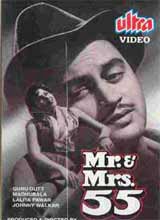
Mr. and Mrs. 55

Now I get it.

This film is both a social commentary and a comedy. The opening scenes sets the stage for "Women's Liberation" versus "love and marriage." An unemployed cartoonist, Pritam (Guru Dutt), has an accidental meeting with a lovestruck, well-to-do girl and becomes infatuated. The girl, Anita (Madhabala), lives with her aunt, Seeta Devi (Lalita Pawar), who is a women's suffragette.

Anita's grandfather has died and left Anita his estate on the condition she marry. Because the aunt wishes Anita to have freedom from the ills of marriage, she seeks a groom willing to marry her niece on the conditions that he not see her after the marriage and that he divorce her soon after.

Pritam accepts the job offer without knowing the details. Once he learns the details, he refuses to be bought but when he finds out the girl he was to marry is Anita, he changes his mind and accepts the offer.

One of the funniest moments in the dialouge is when the aunt, who visits Pritam's humble abode, a rented room, asks, "Are you a communist" and Pritam replies, "No, a cartoonist." Pritam is a man content to live a simple life as long as he is free to live with dignity. He is not interested in material goods.

Meanwhile, Pritam and Anita meet on several occasions before the marriage. Anita is unaware Pritam is her intended groom. Affection grows between them. Early interactions between Pritam and Anita reflect a playful subtext regarding the battle of the sexes.


Anita does not find out Pritam is her future husband until they enter the Judge's chambers. After the civil ceremony, she turns her back on Pritam and refuses to speak to him because she feels he deceived her and is a greedy person.

Soon after Anita and Pritam marry, he gets a job. Unbeknownst to Anita, Pritam has not cashed any of the checks he received in payment for marrying her.

Soon the aunt demands that Pritam divorce Anita. Instead he "kidnaps" her and takes her on a long trip back to his family and his village. Along the way, he continues to try and charm Anita to convince her of his love.

Pritam acts the gentleman and Anita observes his family. In conversation with his sister-in-law, she sees a different side to marriage. The wife expresses a great sense of joy and cheerful duty in caring for her home, husband, and children. My only objection to the sentiments expressed was when Anita asks her if her husband beats her, the wife does not answer directly but says her husband gets angry if he finds his rice has not been perfectly cooked. To include occasional abuse as part of a "happy marriage" is inappropriate.

Anita has grown fond of Pritam but can not sort out her feelings because so many have manipulated the relationship. Her aunt comes to Pritam's village to retrieve Anita. In a burst of frustration with Pritam, Anita returns to her aunt's home. Pritam accepts his fate and stages a photographic session to make it appear he has engaged in dishonorable behaviors so Anita can get a divorce easily. He takes the photographs and the uncashed checks to the aunt. This is where the aunt shows her true colors. Rather than recognize that Pritam has committed a selfless act of love and that he is an honorable person, she pressures Anita to divorce Pritam using the photograph as evidence but does not tell her the source of the photograph or that Pritam returned the checks. Soon Anita learns from Pritam's friend that he staged the photograph and returned the checks.

Anita confronts her aunt with the truth -- and tells her to "go and gain real life experiences rather than giving lectures," because maybe many women are happy in their marriages.

Anita rushes to find Pritam who has made arrangements to fly to Mumbai. As you can guess, the two meet again and make-up.

While the film exaggerates stereotypical negative views of women's suffrage, men should not be rewarded for bad behavior by forcing women to stay with them. The flip side of "women's suffrage" are examples of men who divorce their wives of longstanding for younger wives. The ability to utilize the legal system to redress or remedy injustice or criminal behavior should be available to all.

Madhabala, Guru Dutt, and Johnny Walker provide fine performances. Madhabala's Anita is a bit pouty but she gives an energetic performance and looks wonderful in a black sari as it blows in the wind as she walks through Pritam's village at night. Guru Dutt, who also directed the film, cuts a fine figure and has a good sense of comedic expression as well as an understated expression of emotion. Johnny Walker as Pritam's sidekick is funny. Other secondary characters like the aunt's secretary and Walker's girlfriend also provide fine performances.

Shot in black and white, Guru Dutt made excellent use of shading. At times, the intense contrast added to the mood of various scenes.

Starring: Guru Dutt, Madhubala, Lalita Pawar, Johnny Walker, Yasmin, Kumkum
Screenplay and Dialogues: Abrar Alvi
Cinematography: V.K. Murthy
Lyrics: Majrooh Sultanpuri
Music: O.P. Nayyar
Produced and Directed by: Guru Dutt, 1955

Saturday, October 22, 2005

What I learned from Shah Rukh Khan


In early 2002, after buying a VCR, I began purchasing films. As my film library grew, I decided to broaden my horizons and check the foreign film selections. Among the first foreign films I bought was an Indian film called Asoka.

My previous experience with Indian films was Gandhi. After Asoka’s closing credits rolled down the screen, I was transfixed. Indian films were different from western films. They were three hours long with song and dance routines dispersed throughout. Female actresses looked like real women not like the skinny twenty-year-olds in western films. Men expressed emotions, and multiple generations were represented. Though the dialogue was Hindi, the stories and body language were universal.

I wanted to know more, so I entered the male star’s name, Shah Rukh Khan, into Google and it came up with over a million hits.

It didn’t take long to realize Shah Rukh Khan was a major Bollywood star. To learn more I read about Khan’s life and career. I also immersed myself in his films I got from a local Indian video store.

Some of the best parts of Indian movies, for me, are the song and dance routines, the women’s saris and jewelry, and the doti of the men. I love the energy and style of the dancing, especially the choreography of Farah Khan and Pandit Birju Maharaj. Every woman, no matter her age or shape, looks great in a sari and the men look regal.

Because of many changes in my life during this time, I was grateful to escape into the world of Indian film because it wasn’t here. I could lose myself in another world. I bought a sari and Indian jewelry. I learned a few words in Hindi, drank chai tea, ate Indian food, followed Indian news, and got an India travel guide.

Often when watching Indian movies, you are watching both the story on the screen and also the story of a changing culture. I struggled with the concept of understanding India through its films when I asked myself, “Did western films really reflect the history and culture of my world?” I didn’t think so. But, for the moment, Indian films were all I had.

India’s history is thousands of years old (2500 BC). With a population over one billion, with hundreds of different nationalities and religions, conflict was common.

As I followed Indian news, I watched the nation struggle with cultural conflicts, religious and political, that were often violent. In fact, during the height of my obsession, I had hoped to make a short trip to Mumbai but when the Victorian train station in Mumbai was bombed, I changed my mind. I continue to follow the news in all 29 states and 6 territories of India as they struggle with political unrest, varying economic conditions, corruption, poverty, and the struggle over the sovereignty of Kashmir. India claimed independence from British rule in 1948 after many bitter struggles and the establishment of a Muslim nation, Pakistan and Bangladesh. Kashmir remains, today, a disputed territory.

Indian films reflect these issues and more. In Indian films, you get drama, humor, tragedy, suspense, and celebration.

On screen emotional struggles are often raw and awkward in contrast to the slick dialogue of western movies. In Indian movies, characters are portrayed in exaggerated terms leaving no doubt who is good or evil.

One common conflict in Indian films is forbidden love. Arranged marriages are part of India’s culture but India’s youth are pushing for finding their own love matches, so Indian films reflect this cultural schism.

Another underlying motif of modern Indian films is the historical territorial power struggle of powerful Rajas transferred to political families, large corporations, or corrupt gangs.

Scandals in 2003 about mafia influence in the Indian film industry exposed the corruption that Indian society has not brought under control.

The Indian film industry produces over 800 films a year. It is the biggest film industry in the world.

By the time, I watched Asoka, Khan had become a producer as well as actor. He had been married for over 10 years and had two children.

As I continued to watch Khan’s films and other Indian films, read film reviews and interviews, I came to admire Shah Rukh Khan. His personality shone through in all of his characters. He is a good person. He is generous and passionate. He is energetic, expressive, funny, and attractive.

His philosophy about acting is focused on his audience: “I was here to ask for love. I was here to woo them not impress them. I was here to make them realize I was just one of them, like them, except that my job puts me in different situations and stories. And if I was able to hold up this mirror to everyone I was sure my audience would appreciate me because they would reciprocate their love to one of their own….”

Khan was accessible. He was open and honest in his interviews. He was also humble and some say arrogant. He handled his rise to stardom well. He never lost his sense of himself. He gives god credit for his success. He puts his family and friends first. He is loyal to those who supported him in his career. He took risks. He had become phenomena as one of the most widely recognized and admired stars in India, Asia, and Britain.

Because I found his life’s story interesting, I wanted to understand how he made some of the major decisions in his life. How did he decide to become a film actor? Where did he meet his wife? How did he handle success? How did he handle conflict? How did he choose his films? What were his future plans?

All my questions made me wonder about the concept of a role model. Who were my role models? Should film stars be considered role models? How does one feel about this additional life-long role assigned to them?

Khan has great praise for his parents. His parents were his role models. His mother, Fatima, was an Oxford-educated magistrate. His father, Mir Taj Mohammed, was a freedom fighter and a sensitive, intelligent man. They encouraged him and expected him to do well, but did not put many restrictions on him. His father had started several businesses but was not a great businessman. His family’s economics fluctuated but Shah Rukh Khan never felt deprived.

Khan was intelligent and had determination. When faced with getting a zero in learning Hindi in grade school, he studied late into the night until he got tens.

In college, he majored in mass communication and enjoyed advertising art. He also excelled in sports and wanted to pursue a professional sports career. But, an injury changed those plans. “One cannot be sure of one’s best efforts…. as sometimes your best is just not good enough. And that is one truth I live by even today. One should not get disappointed but try hard next time.” A friend suggested he try television. Khan always turns a negative experience into a positive one.

He loved his parents but lost them early in his life, his father at 15, his mother in his early 20s. He openly grieves their loss in most interviews. “Mother taught me that nothing is permanent…. So enjoy what you have this moment, for it can be taken away from you the next. Everything is transient.”

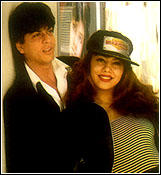
At 19, he fell in love with Gauri Chibber, a Hindu girl. Khan is Muslim. They dated in secrecy because mixed marriages in India are frowned upon. His future wife’s family disapproved of their engagement, so much so his fiancé’s mother went on a hunger strike. Alternating crowds stood outside his home in Delhi to protest their marriage. Hindus came in the morning, Muslims in the evening.

Undeterred, Khan eventually charmed Gauri’s whole family. On their wedding day, he eagerly participated in the Hindu wedding ceremony, which has many rituals. Khan wanted to know the meaning of each one. As he and Gauri, prepared to leave, her family wept over losing her. To ease their pain, Khan offered to let her stay and he would just visit frequently.


He is known for professing his love for his wife, Gauri, and their family.

Khan was a good student but for some unknown reason, Khan’s college dean discouraged him from continuing in college. Yet, Khan is philosophical about the detours in his life, he feels "no experience that you have in life can ever be wasted."

He had success in several television series and decided to try film, so Khan, his wife, and sister moved to Mumbai. In India, it is common for extended families live together.

Khan has won many awards and made box office history with the movie, Dilwale Dulhania Le Jayenge (Braveheart Takes a Bride), which ran to packed houses for over five years and is still running today. Khan is practical about his acting talents, he feels he has a limited range of expressions but he says “If you can pull it off, it’s a performance, if not it was just an accident, try and do it again and again till one day you die.”

Khan's philosophy about business and money is "These four principles cover my business philosophy: You should work for it, you should not lose money in any business, you should make enough money so that you are in a position of choice. And finally, if you start a business employing a lot of people, the end result, regardless of whether it made money or not, should be that all those people involved should be happy that they gave it a shot. He also believes one should have a greed for: knowledge, money so that you can have choice, and love.

Shah Rukh Khan loves New York City, and came to promote Asoka in September 2001. He and his family were only a few blocks away on September 11. As Khan notes, “We could see the clouds of dust and smoke that engulfed the sky…. the situation was so surreal.” Khan sat by the window for hours, “the police coming, the smoke rising and everything, it was very shocking.”

This was my first experience with fandom. I had never been so taken with a star or an industry. I began to see the positive side of fandom as well as the negative.

Life often requires us to review our perspectives, our feelings, our attitudes, our values, and our actions. I had become stale and rigid in my routines and my views of the world and life. Shah Rukh Khan became a role model for me because I learned from him some of the qualities about making good choices, and the importance of hard work, determination, humility, gratitude, loyalty, humor, love, and joy.

In March 2003, I learned Khan was going to have surgery to correct a longstanding back injury. I, along with millions of others, sent him get-well wishes.

Caring about someone even from afar made a difference in my life.

###

Friday, September 30, 2005

Paheli and the Oscars

Everyone has an opinion about the choice of "Paheli" for India's Oscar submission. Some feel other films should have been chosen for various reasons. Others agree with the choice.

For me, as long as the discussion remains on the various aspects of filmmaking, I think it's good to talk about how films are chosen for awards.

I appreciated "Paheli" for many reasons. I liked the idea of recreating a folk tale of a far-fetched idea of a ghost falling in love with a woman. I also recognized that folk tales can also relay wisdom and insight, or serve as cautionary tales. Folk tales hold universal appeal for all audiences.

"Black" and "Mangal Pandey -- The Rising" were among those considered for Oscar submission. Whlle, "Black" is an incredible film -- beautifully crafted and portrayed, the Helen Keller story is well-known and that is one reason why I think it was not chosen.

"“Mangal Pandey -- The Rising"-- is also a well-crafted film and while the idea of seeking independence and overthrowing suppressors has universal appeal, it is an adult theme. Plus, its theme is similar to Lagaan, a recent Oscar winner.

"Paheli" is many things. It is well-crafted and portrayed. It is also colorful, funny, gentle, sweet, sad, and surprising.


I stopped watching Western films many years ago for many reasons. The stories seemed silly or violent for the sake of violence. Every other movie seemed to be about some freak terrorizing teens, or it would be another shoot-em up, car chase, sex for the sake of sex movie.

I walked out of "Monsters Ball" which won several academy awards. I also walked out of "The Green Mile." Both movies seemed emotionally dead and violent for the sake of violence to me. Many fine Western movies have not been nominated for an Oscar, an example is "Frequency" (2000), a successful, well-crafted movie. I understand the reason for awards but just because a movie is nominated or is not nominated does not necessarily mean it is a good or bad movie.

What I seek to take away from any discussion on film-making is a greater appreciation for the craft of making a film in all its various aspects. Plus, I gain a wider perspective of the world when others share their views.

I have noticed one thing since I began reviewing Bollywood films and this observation holds true for all filmmaking. There seems to be two mindsets for how a story should be portrayed. One perspective is what I call "hard-core realism" -- people in this category seem to view the world as a harsh, cold, survival-of-the-fittest place where you have to watch your back and you have to acquire more "stuff" to survive. The other perspective is what I call "Optimistic" -- people in this category seem to view the world as a friendly, hopeful place, where cooperation among family, friends, co-workers, and strangers are the basis for a healthy civilization. Both views are real.

Sunday, September 18, 2005

Quick Take: Mr. India, Mr. & Mrs. 55, The Hits of Udit Narayan, Bollywood All Time Hits V2, Yours Forever--SRK, Main Hoon Na companion DVD disk

Mr. India -- I can see why this film was so popular. It's intrepid girl reporter tracks crime stories; It's megalomaniac wants to destroy the world with high tech weapons; It's mad professor discovers great invention that could be misused by criminals; It's Invisible Super Hero saves the day. All interlaced with some sweet and comical song and dance routines. Amrish Puri (Mogambo) is such a good bad guy. Anil Kapoor (Arun Verma) plays an innocent, compassionate, and sometimes lonely young man, who has made it his life's mission to raise orphans, with a genuine sweetness and depth of character. I loved the camera work that made Arun become invisible and also when it allowed the audience to see his presence in various scenes. Sridevi (Seema Sohni) is very funny and the children are great.

Mr. & Mrs. 55 -- I need to watch this one again -- it is fast-paced, so I lost track of the storyline but I loved the "funny" opening scenes where women's liberation is touted and then the mood shifts to a young woman who is in love with love. The twist is that Anita (Madhubala), the young woman, must marry in order to inherit her grandfather's fortune. Her aunt seeks to find a suitor who will agree to marry Anita for a price, so she can get the inheritance, and then divorce her. Anita is unaware of these arrangements. This is where I got lost. The aunt, Seeta Devi (Lalita Pawar) finds a struggling cartoonist who agrees to marry Anita. Unbeknownst to the aunt, the cartoonist, Preelam Kumar (Guru Dutt), who, by the way, is gorgeous, has already met Anita and is intrigued with her. I fell in love with Johnny Walker, Preelam's sidekick. He moves so fluidly -- his comic timing and his body language are wonderfully funny. I loved his romantic song duet with a secretary under a table. You can't help but smile when he is in a scene. This movie is a classic and I can see why -- dramatic camera work, satirical social comedic script, and great performances.

The Hits of Udit Narayan -- a collection of 32 song-and-dance routines sung by playback singer, Udit Narayan. Many of these songs were new to me. It was Udit's song, "Ruk Ja O Dil Deewanne" from DDLJ (song is not in this collection) that caught my attention. His voice has a wonderful lilt. Often if I like a song from a collection, I will watch the film.

All Time Hits V2 -- collection of 50 song-and-dance routines from Bollywood hits. This collection has many of my favorites including Ishq Kamena, three from Devdas, and several Anil Kapoor numbers. Anil has a wonderful classical dancing style.

Yours Forever...SRK -- includes 25 song-and-dance routines, film highlights, several interviews and film clips.

Main Hoon Na -- the companion DVD disk -- includes Director's commentary, the making of Main Hoon Na, Deleted scenes and outtakes, and more. The absolute best part of the DVD is Farah Khan's commentary as the film runs -- what an introduction to filmmaking -- she answered one of my questions about the film--Why was the underground space where Raghavan and his cohorts planned their terrorist schemes in Darjeeling ankle deep in water? Because for some reason, Farah Khan was unable to get the floor painted black as originally planned.

Saturday, September 17, 2005

Mangal Pandey -- The Rising

Directed by : Ketan Mehta
Producer : Bobby Bedi
Music : A. R. Rahman
Cast: Aamir Khan - Mangal; Rani Mukerji - Heera; Amisha Patel - Jwala; Toby Stephens - William Gordon; Coral Beed - Emily; Kirron Kher, Lol Bibi....
Cinematrography: Himman Dhamija
Screenplay: Farrukh Dhondy
Choreography: Saroj Khan
Music: A.R. Rahman

The topic of this film -- an early rebellion against British rule in 1847 -- is a serious subject.

While the film was cinematically well-done and well-acted, it lacked an inner fire for me.

The story is illustrated through the friendship of Mangal Pandey, a Sepoy employed by the East Indian Company (EIC), and an EIC officer, William Gordon. This brought the story into the personal realm.

The film raised a thousand questions for me like:

Must all rulers be cruel?

What are the true functions of capitalism?

Why do we tolerate slavery?

The list goes on.

What made the film poignant was its timing. It was released just prior to the 58th anniversary of Indian's independence from British colonization (8/15/1947).

I admire Aamir Khan's vision to produce this film. While historical films often do not do well at the box-office, they are necessary to bring history alive and to remind us of forgotten times and forgotten heroes and heroines.

SRK Calendar

USA --

Sept. - Dec. , 2005, - Filming of Kabhi Alvida Na Kehna - New York, USA (the exact dates - TBA)

Saturday, August 27, 2005

An Open Letter to Anil Kapoor


Dear Mr. Kapoor:

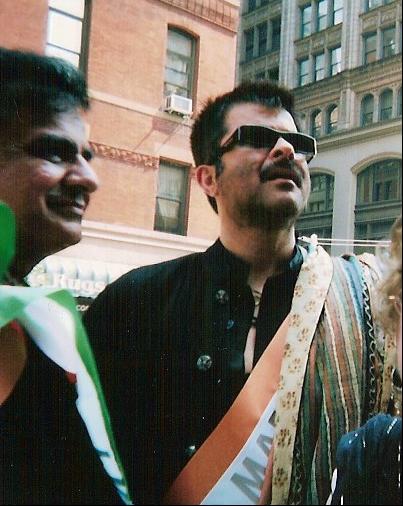
Thank you for accepting the invitation to lead New York's India Independence Day Parade, August 21, 2005.

I came from Maryland to visit a friend and to see you lead the parade. While I am a "foreigner," I celebrate freedom for all people.

I am an unabashed fan of Bollywood -- I enjoy your films.

You spent hours in the hot sun walking the parade route and went out of your way to shake hands with as many of the bystanders as possible. I got the impression you had no bodyguards because the crowds swarmed around you. After you reached the reviewing stand, you continued to shake hands with those around the stand and wave to those you could not reach.

After the parade, you participated in many other celebratory events. It must have been a long day for you.

You are a great ambassador for your country and your profession.

Watching you walk the parade route in the hot sun is an example of why I think Bollywood stars are the hardest working actors in the film industry. Many Bollywood actors do their own stunts, dance and sing (even if it is later dubbed), and then many perform live in other venues as well as serve as guest-of-honor at various events. Also, I think Bollywood stars appreciate their fans more than other film stars.

Luckily, my friend, Jona, was a much better photographer than I -- her pictures of the parade and you came out wonderful.

Thanks again for coming all the way to the United States to celebrate the 58th anniversary of India's Independence.

Namaste --

Saturday, July 30, 2005

Revisiting Taal

Producer: Raju Farooqui and Subhash Ghai
Director: Subhash Ghai
Music: A.R. Rahman
Cinematography: Kabir Lal
Art Direction: Sharmishta Roy
Choreography: Shiamak Davar, Ahmed Khan, Saroj Khan
Playback Singers: Udit Narayan, Sonu Nigam, Srinivas Patro, A.R. Rahman, Anuradha Sriram, Sujatha, Alka Yagnik
Starring: Anil Kapoor, Akshaye Khanna, Aishwarya Rai, Alok Nath, Amrish Puri,

An Indian friend of mine from New York loves the movie Taal. We are both fans of many of Bollywood's leading actri.

Often when we correspond, she would throw in a good word for the movie Taal.

I had gotten the video of Taal and watched it once, maybe twice. I just couldn't see the attraction. But, Taal kept being mentioned in various Bollywood articles and reviews as a great movie. So, I decided to watch it one more time, to see if I could figure out its appeal.

I am glad I did. I think it's always wise to watch a film more than once because so much is missed in one viewing. Since I had already watched Taal more than once, I did not expect my view to change.

My original conception of the story was -- Rich boy meets poor girl. They fall in love. Their families clash over the relationship. The couple separates. Fame sidetracks the young girl. A crass music producer/director lures her into the entertainment business and for the sake of her family she complies. In the meantime, the young man takes steps to convince his family he is truly in love with the girl and believes they will come to accept her. He haunts the girl's workplace to remind her of his undying love. But, because of unresolved insults to her family, she does not relent and eventually accepts a marriage proposal from the music producer.

At first, it was hard for me to buy into the drama of the clash between the two lovers, Mansi and Manav, (Aishwarya Rai and Akshaye Khanna) and their families. Because one family was from a village, the other from the city, one poor, the other rich, a clash was inevitable.

Also, when I first viewed Taal, I had a image in my mind of Anil Kapoor's acting abilities. For some reason, I did not like his character in Taal, a profit-obsessed, shallow businessman.

While Aishwarya Rai played her character beautifully and the movie showcased her beauty and talent superbly, I did not feel the same about the other characters.

I think my first impressions colored the rest of the film for me and I missed some of the subtle changes. In addition, remember, while body language is universal, I only have the captions to give me an idea of the conversations.

But, when I watched it again, I found the underlying themes in the story more interesting. In addition, the movie was also a cautionary tale highlighting the unglamorous side of the entertainment world.

Amid a complex relationship between their neighboring families, London-educated, Manav Mehta, son of a rich man, meets Mansi, daughter of a poor folk singer, in a variety of ways -- first as a image captured from a picture, then in glimpses of her in her village, after he falls down a mountainside, at a visit to her home, at a party at his home, at a friend's wedding, at her secluded spot in the mountains where she practices yoga, at a public ceremony, and so on, until the two fall in love.

Manav predicts the future clash of their families but he also promises Mansi a true and undying love. One underlying theme presented here is that people find god in many ways, in books, in idols, in the flame of a lamp, or in myths and beliefs. For Manav, god resides in his heart. He speaks and acts through the god in his heart. He says he is honest, true, loyal, and gentle and Mansi's love for him is a belief and trust in him.

The film revolves around music both as tribute to magical and beautiful music and as an illustration of the unsavory side of the music business. Mansi's father is a poor folk singer. Mansi and Manav's families have already clashed by the time they visit Vikrant Kapoor (Anil Kapoor), the music producer/director. They learn how Kapoor steals folk music, including Mansi's father's songs, and reworks them into popular songs. Kapoor offers Mansi a job -- as a singer. She accepts.

In the meantime, Manav works to convince his family to accept Mansi. He also learns of the humiliation Mansi and her father suffered in a visit to his home. Using reason and commitment to his promise to Mansi, he challenges the basic belief that a family can be ruined by a poor choice of in-laws. The family sees it as a clash between sophistication and simplicity, implying that the rich are morally superior to the poor, but their actions and behavior demonstrate otherwise.

As an Indian woman, Mansi walks a fine line. She does not publicly voice strong opinions but must be quietly fierce in defense of her honor and the honor of her family. As Mansi's career develops, she slowly adopts some of the business's characteristics. She cuts herself off from her feelings. We are asked to see that success does not always bring happiness.

Aishwarya Rai is showcased beautifully in multiple song and dance routines -- music video style. The film's music also illustrates many of the film's themes.

The beauty of women has been used since humankind rose from the mud in many ways. In images and words, beauty is defined by a woman's body; but women's bodies have also been used to embody evil or as resources to be conquered and subjugated. Humankind uses woman's body as an expression of its aspirations and its ills.

Indian filmmaking uses images of beautiful women as the embodiment of purity and spirituality as well as images of women as the embodiment of vice and base emotions. In Taal, you see Mansi peek out from her head scarf in public gatherings. You see her dance and sing in her village and then on stage in scenes of pastoral beauty and lavish glamour. Whereas, Manav's aunts, dressed in suits, wear grim faces as they watch Manav and Mansi's relationship develop and as they attempt to derail it.

Culmination of the story illuminates much of Kapoor's character. Underlying the tough facade is a sensitive man. In one scene, he defends the honor of all women by refusing to let any of his "stars" appear in lingerie or nude pictures. In the final scene, Kapoor recognizes that Mansi is still in love with Manav and releases her from her promise to marry him as he steps back into his role of music director. He directs her to run to Manav. Anil Kapoor did an excellent job portraying the complex character of the music producer.

Critics of Bollywood say Bollywood films are simplistic, or unrealistic, or unpolished, or too long, or.... I say Bollywood films are multi-layered. On the surface, they can appear as caricatures of human interactions, but if you catch some of the underlying themes, the stories take on a deeper universal meaning. Also, it is Bollywood's style to make it clear who is good and who is evil. As for length, often Bollywood scenes are generous, they allow time for various aspects of the characters and story to develop. Taal exhibits some of these qualities.

Saturday, July 16, 2005

2005 Dilwale Dulhania Le Jayenge Celebrates 10 Years of Continuous Screenings

Released 10/20/1995
Producer: Yash Chopra
Director: Aditya Chopra
Screenplay: Aditya Chopra
Music: Jatin Pandit, Lalit Pandit
Lyrics: Anand Bakshi
Cinematography: Manmohan Singh
Art Direction: Shamishta Roy
Choreography: Saroj Khan, Farah Khan
Playback singers: Udit Narayan, Lata Mangeshkar, Kumar Sanu, Asha Bhosle & Abhijett, Pamela Chopra and Manpreet Kaur
Starring: Shah Rukh Khan, Kajol, Anupam Kher, Farida Jalal, Amrish Puri, Satish Shah, Pooja Ruparel, Himpani Shivpuri, Mandra Bedi, Parmeet Sethi and more.


Dilwale Dulhania Le Jayenge (The Brave-hearted Will Take the Bride) is India's "Casablanca," a film made without any idea of its future success and fame. It captured a nation's heart and changed Bollywood filmmaking. This year, DDLJ surpasses 500 continuous showings setting a record. The film is still shown in Maratha Mandir Cinema in Mumbai and has been featured in various film festivals, nationally and internationally.

From my perspective, it is story about the fulfillment of a young girl's romantic dream of love.

The overall tone of the film is light-hearted, joyful and playful -- for example, early in the film, Simran (Kajol), the oldest daughter of a London-based Indian family, sings of a dream lover and dances with joy reflecting youthful innocence and exuburance. When her father Chaudhry Baldev Singh (Amrish Puri) receives a letter from his old friend back in his Indian village, Simran is reminded of her arranged marriage to her father's friend's son. Her dream is shattered.

Simran's friends convince her to take a month long trip with them on Eurorail. Simran persuades her father to let her go as a last outing before her marriage.

Raj Malhotra (Shah Rukh Khan), the carefree, mischievous son of a rich business man, has also planned to take a trip with his friends on Eurorail before he enters his father's business. Simran and Raj cross paths during the trip and after a series of misunderstandings and misadventures, they fall in love.

The crux of the story is how will Raj and Simran get back together. Simran has gone to India to get married. An Indian marriage ritual is celebrated for several days before the actual marriage ceremony. Raj has just a few days to figure out a way to charm Simran's father into letting him marry Simran. This appears to be an impossible task because promises have been made and Bauji's honor is at stake if Simran does not marry his friend's son.

Even Simran believes it is impossible when she pleads with Raj to elope with her. But, Raj wants her father's permission to wed Simran because while he, too, has lived in London all his life, he is Indian in his heart and wants to uphold tradition.

Vignettes of members of both the bride and groom's family illuminate their outlook and character. Simran's mature younger sister is her confidant. Simran's mother is her friend. At one point, Simran's mother (Farida Jalal) offers to assist the young lovers in eloping but Raj convinces her that his way is right. Ajit Singh's son, Kamalijeet, is portrayed as a selfish, brutal man. Simran's Aunt plays Raj's father's romantic interest. Grandmothers, Aunts, Uncles, siblings, and friends fill the house with activities surrounding various stages of the marriage preparations and celebrations.

The movie is full of humorous moments. Raj flirts with Simran, his piano-playing gymnastics are a hoot, and he continues to tease and play jokes on Simran. I appreciated the subtle humor of the love song between Simran and Raj as they revisited their time together in Europe in fantasy. Now all the times Raj was inconsiderate, he is sweet and thoughtful, and all the times Simran was angry or ungrateful, she is cheerful and affectionate.

Interlaced with wonderful song and dance routines, the movie maintains a fast pace. Early in the film, while the group of Eurorail travelers attend a party, Raj's surprise song and dance routine that he performs to entertain his friends is funny, full of energy, and flirtatious as he sings to Simran. Plus, Simran's drunken escapade through the streets of Switzerland is wonderfully funny as Raj races after her. Also, during the marriage celebrations, Raj slips his way into the proceedings and leads a wonderful counterpoint dance with the ladies.

In the end, while the young people do not follow the traditions of their elders in the same manner, they retain what they perceive as the important facets of their traditions, chastity, loyalty, respect, commitment, and honor.

Music ties the story together with the recurring haunting notes from the song, Tujhe Dekha.

DDLJ Info Bits ----

According to author, Anupama Chopra, DDLJ director, Aditya Chopra, son of director and producer Yash Chopra, has become an enigma. He rarely gives interviews and prefers anonymity because he likes to go to movie theatres to watch new releases without being noticed.

DDLJ's theme is that generations of non-resident Indians the world-over can still hold traditional Indian values. That sentiments about non-resident Indians are expressed at all, I find interesting. I wonder if it is India's strong emphasis on family ties that reaches across borders to distant relatives and countrymen.

Saturday, June 25, 2005

Paheli (Riddle) About The Magic of Love -- Opening Night 6/24/2005

Paheli opened in Laurel, Maryland last night. The theatre was three-quarters full.

I loved it. When I walked out, I thought, "Hey, there were no fight scenes. No one was killed." How often can you say that?

Ok, in case you wondered, the film stars Shah Rukh Khan, Rani Mukherjee, Anupam Kher, Juhi Chawla, with guest appearances by Sunil Shetty and Amitabh Bachchan.

What was it I loved? It was colorful and funny. It was a fantasy. You could lose yourself in the story and yet peer into life's dilemmas.

The story based on a novel by Vijayadan Detha is a marvelous adaptation of his folk tale, "Duvidha." The use of animated characters and a bit of special effects set the stage for a magical story. To me, it is a husband's cautionary tale -- be the love your wife desires and you shall reap bountiful rewards.

Two delightful puppets (voice overs: Naseeruddian Shah and Ratna Pathak Shah) assist in the story narration.

After her marriage, Lachchi travels by caravan to her future home. When the caravan stops to rest near an oasis, Lachchi passes under a banyon tree and a ghost sees her and falls in love with her. The ghost appears in many forms in attempts to attract Lachchi's attention. After the caravan leaves, the ghost is tormented by his love for her.

The husband, Kishan (SRK), is a prig. All he cares about is money not romance. Kishan tells his new wife "making money was the foremost duty of a trader." "Only wealth matters," he says as he leaves the morning after their wedding. His journey to outlying villages to collect taxes and barter for goods will take five years. Lachchi, his wife (Rani), cannot come to terms with the situation even though she is surrounded by loving in-laws. While her sister-in-law, (Juli Chawla), tries to console Lachchi by telling her the story of her husband's abandonment, Lachchi longs for the love she had hoped for.

Kishan stops at the same oasis to take a break. Curious, the ghost takes human form (Aasif Sheikh) and learns that Lachchi's husband has left her for five years. He takes the shape of her husband and comes to the family home as their son. At first, the ghost as the son, Kishan, must convince the father (Anupam Kher) that his return will be profitable. Once convinced, the father and family welcome him lovingly. When the imposter enters Lachchi's bedroom where she waits, he tells her the truth and pours out his heart. He tells her his love is true and undying and asks her to accept him. He gives her a choice. He is ready to accept her rejection. Torn between wanting to be a loyal wife in a loveless marriage and the gift of eternal love, Lachchi chooses love.

For a few years, the imposter Kishan and Lachchi live as a loving couple within her extended family. Love is SRK's theme and in this role he shines as a loving husband, son, neighbor, and father.

During this time, various events illuminate some of the family's history. Interlaced, in this time period, are the odd messenger (Rajjpal Yadav) who claims to have been sent by Kishan from a distant village, and similar remarks by others that are dismissed, especially as they can see Kishan is here in his home.

While the sets and costumes were lavish, the story took center stage, and as the imposter's plans are foiled by the early return of Lachchi's real husband, the story continues to provide many surprises.

If blood and gore is what you want in a movie, or if you like fight scenes and gritty realism, Paheli is not your kind of movie.

Another thing I loved was SRK looked healthy. After seeing Veer-Zaara, I was frozen with concern. SRK was too thin in that film, with Paheli, I can relax.

http://www.pahelithefilm.com/ feedback@pahelithefilm.com

Director: Amol Palekar
Cinematographer: Ravi K Chandran
Choreography: Farah Khan
Action Sequences: Allan Amin
Film Editor: Amitabh Shukla
Music: M.M. Kreem
Lyrics: Gulzar

Wednesday, June 15, 2005

Quick Take: Veer-Zaara, Swades, Bride & Prejudice, Kaal, Waqt, and Bunty & Babli

Veer-Zaara--I am silent on this film because SRK's appearance affected me. He looked much too thin.

Swades--I am happy to say that SRK came to my hometown, Greenbelt, MD, to film several scenes set at the Goodard Space Flight Center. I enjoyed Swades and appreciated its message asking that NRI's contribute to the country of their origin.

Bride & Prejudice-- loved this film. It was wonderful to see and hear Ash in English. I got a kick out of the western style song and dance routines the sisters performed. Plus, I loved the crowd of street dancers. I went with my sister, mother, and niece and we laughed alot. It was such fun. Upon another viewing, I found the character, Mr. Kholi especially delightful. While portraying an unpolished outlook, at the same time, he was sweet, funny, vulnerable, and kind.

Kaal-- I read several articles prior to seeing the movie, so I was prepared for the story. The story went as I expected. I did appreciate the sentiment expressed over the loss of habitat for the lion. Also, I appreciated the camerawork. But, I missed the mix of a variety of characters and the complex storylines.

Waqt--I liked this film for its silly extremes.

Bunty & Babli-- What a riot of a movie. Lots of funny capers and wonderful song and dance routines. Mr. B's (Amitabh Bachchan) character was quirky. Rani Mukherjee seems like she can do no wrong. This may be the first movie I have seen with Abhishek Bachchan. He was quite good. He had to play a variety of emotions and in one scene did a wonderful job of pretending to be a phony salesman.

Tuesday, February 22, 2005

Audiences, film publics, and ticket-buyers

Who decides the audience for a film? The director, producer, scriptwriter, or the cast? They all have a vested interest in the success of the film but who decides the audience the film speaks to?

Will it be a love story for the young, for the old? Will it be a comedy, slapstick or subtle? A mystery or misunderstanding to be solved? Will it be historical or fantasy?

The reason for my questions is another attempt to address Bollywood film critics and western movie makers.

In western films, usually it is a single homogeneous audience that is targeted like young males, or lovers and couples, or children. Only a few films are considered family-movies where both adults and children alike can enjoy a movie together. Not so, with many Bollywood films. Often a Bollywood film will have two or three stories running simultaneously and often the various stories feature children, youth, and adults, so that the film appeals to old and young, and male and female.

My reason for pointing this out is that I find few western films that consider audiences other than young males. Yet, Bollywood critics seek to homogenize their films into a concentrated form that also will appeal to primarily young males. How can Bollywood critics complain about low ticket sales if they don't make movies for a variety of audiences?

Who buys film tickets? I have no demographic information at the moment, but if Shah Rukh Khan is considered one of the most highly appreciated stars in Bollywood, it is because many of his admirers are women. They are buying a lot of film tickets.

Saturday, February 05, 2005

Black is Blue, Brown, and Light

BLACK

Producer: Applause Entertainment
Director: Sanjay Leela Bhansali
Cast: Amitabh Bachchan, Rani Mukherje

Director Sanjay Leela Bhansali offers this film as a tribute to Helen Keller. It is a remake of the Helen Keller story.

I am a filmgoer not a critic. So, I don't always use the proper terms for the technical aspects of filmmaking when I describe how I experience a film.

Sometimes I think film critics forget not all filmgoers are as aware of all the technical aspects of filmmaking as critics. Like a wine connoisseur who has more taste buds than the average person and can taste subtleties missed by others, a film critic focuses on details in the structure, characterizations, plot, dialogue, camera work, direction, musical score, lyrics, choreography, and more to a finer degree than an average filmgoer.

As a filmgoer, I am more forgiving of a plot that may take a bit of imagination to piece together as a whole, or characterizations that may be bolstered by affection for the actri, or dialogue that may be mentally revised to suit the scene.

If you are familiar with the Helen Keller story, the director sticks close to the story including the famous dining room scene and water scene. Because in this story, Michelle, the blind and deaf girl, has a male teacher, the director, while staying with the original story, must take a slightly different slant when he tells how Michelle and her teacher grew over the years to reflect the successes and missed opportunities that Helen and her teacher, Anne Sullivan, experienced.

The cinematography in "Black" is a large part of the film. Most scenes are beautifully cast in a variety of shades of blue and brown with light streaming in or illuminating parts of the scenes. The use of color and light recalled the film "Barsaat" by Raj Kapoor with his dramatic use of black and white shading.

Rani Mukherje has become a surprisingly good actress. I first saw her in "Hey Ram" and her character, while played well, did not stand out. Then she seemed to burst on the scene as a screen model, glamorous and pretty. Now, she is everywhere. I saw a bit of her talent range in "Calcutta Mail." She is expressive, funny, and a good dancer. She is a quick study and improvises on the spot. Playing Michelle in "Black" appeared to be a challenging role for Rani. Rani does not have a stoic face, so she seemed quite expressive at times when I expected a more solemn countenance. But, Rani developed her own style to express the hesitating walk and perplexed expression of a blind and deaf person.

The young girl, Ayesha Kapoor, who played Michelle as a child, did an excellent job. She is a natural actress. She seemed to flow in the role and move through the scenes flawlessly. How did a young child learn to mimic the face of a blind person? She is most convincing.

I had only seen Amitabh Bachchan in recent films like Mohabbatein, KKKG, Veer-Zaara, and Baghban. I had no way to judge his performance in “Black” against his earlier work. But, his energetic and sympathic portrayal of Michelle's teacher, Mr. Sahai, took my breath away as he took on the challenge of teaching Michelle and devoted his life to her intellectual growth.

One thing I like about Bollywood films is they are not afraid to illustrate the varied history of India, openly or subtly, in their stories. In this story, Michelle comes from an Anglo-Indian family. With no reference to the past, you instinctively know that the alliance stemmed from the history of British colonization.

At times, I found the opulence of the settings oppressive. What is the purpose of opulence if not to impress?

I missed several aspects in this film that I find in many Bollywood films. There were no song and dance routines. There were no substantial secondary characters or multiple themes. In my mind, these missing aspects limit “Black” to a highly-perceptive adult audience. Also, except for a western-style wedding, there were no rituals in any scenes. I had become used to seeing various temple and worship rituals in Bollywood films, so their absence was noticeable.

But, in a healthy film industry like Bollywood, it is nice to be able to view the vision of different directors, and the talent of many fine actri and filmmakers. Bollywood films don't have to all be the same. “Black” is a stunningly visual film, and a finely crafted and portrayed story.

One memorable line came when the college trustee says to Michelle's teacher, "Science does not believe in miracles."

My only objection was -- when are movie theaters going to change their menus? Popcorn, candy, soda, and nachos and cheese are fattening and poor nutritional food choices. I suggest that movie theaters reexamine their snack selections. Movie theaters are behind the times. Restaurants and fast-food venues have revised their menus to include vegetarian choices, fruit and fruit juices, vegetable snacks, decaffeinated beverages, and more. Why not movie theaters?

p.s. if you are paying attention to this blog, you may note that this is my first review of a non-SRK film.

Sunday, November 14, 2004

From the Statesman--Rage Worship

by Shoma A. Chatterji
11/2004

I took the following statement from Chatterji's article "Rage Worship":

"the random use, abuse and misuse of violence by the average hero of the average mainstream film have reduced him to a marketable commodity devoid of human values. He mirrors the terrorist in Punjab and Kashmir, the fascist in Gujarat, the regional facist of Assam, the legitimised army killer and rapist in Manipur much more than he is in any way close to our mythological heroes Ram, Ravana, or Yudisthira..."

to heart as I watch the increase in the acceptance of violence as a means of governing world-wide.

There is no more perfect slave culture than a population that had been oppressed by fear, violence, and poverty.

Chatterji's statement applies to Western films and culture, too, and to my mind, as a westerner, much more so, because Western films have reduced violence to an entertainment value without any social context. Western films portray acceptance of violence as a way of life. Just as Bollywood and India have fought corruption in their industry and in their culture, the United States seems to be run by the mafia. Our government and our industries are run by thugs and thieves who enjoy robbing and killing their own people. They are destroying their own economic engine--the middle class--for short-term personal gain. Our government has a history of genocide starting with the Native Americans, African Americans, and Mexicans. We took their land, we enslaved their people, we throw their governments into turmoil by supporting civil war, and it seems that our government wants to continue this policy in the Midddle East.

If the United States was instrumental in saving Europe from Nazi domination, who will save the world now from the United States?


Saturday, November 13, 2004

Ram Jaane

1995, Hindustani, color, 172 minutes, Eagle Films
Director: Rajiv Mehra; Producer: Parvesh Mehra; Cinematography: S. Pappu; Story/Screenplay/Dialogue: Vinay Shukla; Audiography: Karnall Singh
Lyrics: Anand Bakshi; Art Direction: Nitish Roy; Music: Anu Malik; Action: Mohan Baggad; Choregraphy: Nimesh Bhatt; Playback Singers: Udit Narayan, Abhijett, Alka Yagnik, Sadhana Sargam, Anuradha Shriram

Cast: Shah Rukh Khan, Vivek Mushran, Juhi Chawla, Pankaj Kapoor, Punit Issar, Tinnu Anand, Deven Varma, Gulshan Grover

I thought I’d seen most of the film highlights of SRK’s career to date. On a visit to a local Indian video store, I picked up Ram Jaane, a film made early in SRK’s career that I hadn’t seen.

I watch Bollywood films more than once because there is so much to take in. The first time I watched Ram Jaane, I found little to like.

Coincidently, the gangster motif in the film juxtaposed in my mind with a recent interview I heard on NPR about the influence of the underworld on Bollywood films. It was like a visual presentation of the underworld lifestyle.

But when I watched it again, I saw much more to like. I was able to get past the violent nature of many of the characters and scenes.

Ram Jaane is a story that questions society. Two boys are orphans and friends. One, Ram Jaane (Shah Rukh Khan), is street smart and fearless, the other, Murli (Vivek Mushran), is gentle and kind. The first becomes an accomplished underworld operative, the other grows up to run a home for orphans. As adults their paths cross again when a childhood friend, a girl, Bela (Juhi Chawla), returns to the neighborhood. Both have a romantic interest in her but Murli does not express his desires because he knows Ram Janne is interested in Bela, too. Murli feels he owes Ram Jaane his life because when they were young and running the streets together, Ram Janne had saved his life.

But Bela loves Murli and tells him so. All of this occurs against a background of criminal and political corruption. Ram Jaane has scores to settle and in the process kills several people. To catch Ram Jaane, the police and thugs clash with Murli and his orphans. By threatening Murli’s home for orphans Ram Jaane attempts to intervene and is caught.

In an eloquent courtroom presentation, Ram Jaane points to society and the legal system as participants in his crimes, the crimes of the underworld, and corruption of public officials like the police. By turning a blind eye to corruption, the legal system has created an environment where orphans turn to crime.

Beautiful Juhi Chawla is wonderful as Bela. She has many moving scenes and also quite a few energetic dance numbers that show off her talents as an actress and dancer.

Vivek Mushran as Murli gave an understated, muted performance, perfect for his role as a quiet, gentle man whose mission was to help orphans.

One surprise in this film was SRK’s acting style. While I caught glimpses of his trademark style, in this film his style has not been perfected. His style is rough in places but consistent with his character. SRK’s character is often crude, fearless, loyal, violent, honest, and naive.

Elements of the storyline overrode any objections I had about SRK’s acting style, as with many Bollywood films, the social statements are an important part of the story.

Postscript--After watching Ram Jaane again, I felt SRK's final prison scene is one of his best.

Sunday, October 31, 2004

I Vote Yes to Keep the Dance and Song Routines

I want to counter those who criticize Bollywood films. Some say they are less polished than "western" films. But, Bolllywood has it's own style and that style is valuable. Many Bollywood films are layered with various stories and themes. They are also realistic, so if emotional scenes seem raw, this is because in real life emotional scenes are raw. I enjoy the multi- layered and -themed characteristic.

Several critics claim the dance and song routines are unecessary especially in dramas. But, show me any other film industry that invests in musical talent as much as Bollywood. I love the fact that Bollywood films support all the arts by showcasing choreography that reflects national dance styles, and singers, musicians, and lyirists.

My vote is that Bollywood keep that which it has made unique and wonderful.

Sunday, September 05, 2004

Shah Rukh Khan and the Temptations Show 9/4/2004

Shah Rukh Khan came and I saw him live at the MCI Center in Washington, DC.

Since becoming immersed in Indian films in 2002 and becoming a fan of Shah Rukh Khan, I made it a goal to see SRK in person.

I read Indian news and use the Internet to keep up with SRK's doings. When I heard he was going to lead the India Independence Day Parade in New York in 2003, I caught a train to New York. Unfortunately, he was running late, and I had to catch a return train home, so I missed him. But, I did make friends with an Indian woman who stood next to me along the parade route. We still communicate.

Then, I found out SRK was going to do a variety show tour that included a night at the MCI center. I knew where I would be on 9/4/2004.

I wore an beautiful dark green Indian outfit with silver Indian jewelry bought especially for the show. My niece came with me. It was great to be among a crowd of women in Indian fashions. I love saris and other Indian fashions. They are beautiful. My family and friends really liked my outfit.

I was not disappointed in any way. Everything that is said about SRK is true. He has enormous energy and is very personable. The show ran for over three hours and SRK was on stage alot. Towards the end the stars did a medley of songs from SRK's movies and I was dancing in the aisle. I was so comfortable with the music, I knew all the songs.

SRK interacts with the audience. He invited people on stage and danced with them.

The audience roared and cheered SRK and the other stars throughout the show. There was no shortage of enthusiasm.

While our seats were in the upper level and SRK, Rani Mukerji, Preity Zinta, Priyanhia Chopra, Saif Ali Khan, and Arjun Rampal looked tiny down on the stage, I still enjoyed the show. A troupe of dancers backed up the stars in the musical numbers.

While I like all the other stars in the show, I came to see SRK.

An odd yet true reaction I had seeing SRK in person was that it was like seeing him in film that is how much his personality comes across in film. I had to remind myself this is live, he's really here on stage talking, dancing, and singing.

He thanked the audience, the convention organizers and many others for supporting him and the tour many times. He let the audience know he wanted them to have a good time.

While many of the dance numbers were modern, Rani and Priety performed a traditional dance routine towards the end of the evening. It was beautiful.

I like the fact that Bollywood stars reach out to their fans. To my mind, Bollywood stars work harder than other film stars. I also like the fact that in Bollywood the music is an integral part of the films.

Another thing I love about many Bollywood movies and this show is that they are geared toward multi-generational audiences.

I am still thinking about the show, letting it sink in that I really got to see SRK. Probably the sign of a real fan. I realized that SRK is so real, you can count on him to be honest, kind, professional, positive, energetic, generous, and hardworking.

I hope my pictures come out.


Tuesday, July 27, 2004

Here's another thing I like about Bollywood

I just got finished reading some news of Bollywood on various internet sites and it struck me that one of the things I love about Bollywood is because they make so many films, everyone can find one they like. Everyone can find actors, actresses, backup singers, directors etc. that they like.

I began to realize that those who criticize SRKs for his "feel good" movies were people who preferred stories with more "realistic" aspects. They seem to qualify "feel good" movies as being less appealing intellectually, or creatively. But, in the world of artistic expression there are a variety of styles, as it should be.

SRK is India's "Disney." Pardon my comparison to Hollywood.

Friday, July 23, 2004

Shah Rukh Khan is Coming to the MCI Center 9/4/04

The minute I wrote that headline, I panicked.

The United States is in a terrible place right now. Our government is considering postponing our national elections due to threats of terrorism. September is close to November when elections are held. Fear and concern ran through my mind. I pray SRK and his troupe come to the USA without any hassles or harm.

Anyway, SRK and a troupe of Bollywood stars are coming to the MCI Center in Washington, DC on Saturday, 9/4/2004. For more information, call 1 800 551 7328, 703 658 3171, or email: bollywoodc@aol.com.

Wednesday, July 21, 2004

Disappointed

A quick note, I am disappointed that three of Shah Rukh Khan's films were not fully appreciated. They are Asoka, Dil Se, and Phir Bhi Dil Hai Hindustani.

Asoka was my introduction to Indian film. After watching the movie, I knew it was unique. I read various comments about Asoka. It was viewed as a risk because it was a semi-historical film. Critics found fault with its facts. Sometimes films are meant to convey an impression not to enact an exact reality. Because of Asoka, I did a lot of reading about India's history and about the career of SRK. I found both absorbing.

By the time I saw Dil Se, I had watched many of SRK's early films. I found Dil Se beautiful. A sad film can be beautiful. The story treated the subject of terrorism with realism and compassion. There was something about SRK's performance I had never seen before, to say he was more natural isn't quite right; I think it was his most emotional role. The choreography was more than striking; it was inspired.

Phir Bhi Dil Hai Hindustani, a SRK production, to my mind was a love letter to the Indian people. The story is about a father who kills his daughter's rapist, a government employee shielded by influence. It is also a story of how the corruption is uncovered and how the Indian public comes to support the father. Plus, I think it is SRK's funniest role. He likes comedy and I think his parody of himself and others as media idols is a stitch. Juli Chawla is also wonderful in this movie. As with many Indian movies, humor, tragedy, romance, and drama are woven into the story.

All this does is remind me I need to catch up on so many stars like Juli, Ash, Manisha, Maduri, Kajol, Anil, Chandrachur, Jackie, Sanjay, and so many more. For each time I branch out, I find more to love about Indian films.

(c) 2004 Canary Press Co.

Tuesday, July 20, 2004

Main Hoon Na--It's also about having fun

Almost everyone knows about "Main Hoon Na", the Shah Rukh Khan backed film debut by director, Farah Khan.

I am sensitive to violence and try to avoid it but with Indian movies that has proven hard to do. The underlying theme of Main Hoon Na is the tense relations between India and Pakistan. There are several scenes with violence. While I could cover my eyes, I couldn't block out the sound.

I appreciated the underlying story of attempts to make peace with Pakistan and to illustrate the horrors of past conflicts. This is another thing I appreciate about Indian films. Most call them escapist but they are hardly that when many feature subplots regarding corruption, deception, abandoned children, abused women and, of course, violence. These elements are not far from the reality of many Indians. Most Indian movies try to end by solving the plot conflicts, by having the bad guy get captured, jailed, killed, or in some way punished. Indian films raise many social issues and attempt to correct injustices.

In the film, terrorists threaten to disrupt a fragile peace process by threatening the life of the Army General's daughter. Major Ram (SRK) is sent to her college town to act as a student and serve as a bodyguard. At the same time, he is on a personal mission to find his half-brother Lakshman (Zayed Khan) and heal old wounds.

Other reviews have dealt with the various subplots and pivotal scenes, suffice it to say that the General's daughter; Sanjana (Amrita Rao) and Lakshman are used by Raghavan (Suniel Shetty), the terrorist, in an attempt to derail the exchange of Pakistan and Indian prisoners of war.

Luckily, most of the movie focuses on the college antics of Sanjana, Lakshman, and their classmates which spells out lots of songs, dances, and fun as Ram gets to know Lakshman, his mother, Sanjana, and the college chemistry teacher.

I loved so many scenes, the opening dance number, Ram’s comic fashion changes, the fantastic song and dance dream sequences, and the humor.

I did appreciate the special effects in the confrontation scenes with Ram and Raghavan. I have to say though, I hated to see SRK take the body blows and falls. I winced because I was aware of his back problems.

Zayed Khan (Lakshman), who stepped in to replace Hrithrik Roshan, did a great job; some reviewers dissed his dancing skills. But, I say hey, the guy dances, for me that's more than enough plus he has his own sweet style. I love men who dance.

Sushmita Sen as the chemistry teacher was elegant. Amrita Rao has a lot of style. Her acting was very convincing and her dancing was charming. I don't know how tall she is but she looks like a sprite, so tiny and delicate. The supporting cast was great, too.

I loved the ending of the film when they introduced the credits. The various scenes make me laugh and I dance to the music. The only disappointment was Gauri Khan, the producer and SRK's wife, did not put in a personal appearance. My guess is that Main Hoon Na credits may be the only film credits that are read in their entirety.

I also appreciate the fact that SRK is so open in his interviews; I have learned a lot about film making from him. I appreciate the fact that he wants all his films to succeed on many levels and he is willing to go the extra mile to achieve that. After months of hard work, the filmgoer is transported for a few hours.

For me, Main Hoon Na is like the end of a long pleasant trip. I have followed SRK’s career since 2002, purposefully going back to his early films in an attempt to watch him grow as an actor. I think I achieved that. Khan has grown as an actor. While watching Main Hoon Na, it was hard to remember him in Deewana as the young man in love, who shook with the realization that he now wanted something in his life, a woman, a wife, and who cried bitterly as he pounded a brick wall. He jumped with energy, had a baby face and flying, black hair.

Khan has grown into a handsome man with chiseled cheeks, his hair trimmed and slicked back. His acting is polished. His emotional expressions while forceful are more tightly controlled. He's the adult now mingling with youth. A role reversal. But, his energy and joy of life still shine through. Now that I am watching SRK in real time, it's interesting to see the various mature roles he is taking on in films like Montabbein, Devdas, Chalte Chalte, and Ka Ho Na Ha. This is another thing I like about Indian movies, Indian movie stars really work hard their whole career and since Indian movies are multi-generational, stars can play a variety of characters their whole lives. To my mind, western movies focus almost entirely on youth.

In human relations, Shah Rukh Khan's generosity to others is paid back like some law of physics that says the more you give the more you get.

There are many reasons why Shah Rukh Khan is a star. One basic reason is the camera loves him. He looks good from any angle.

What will Farah Khan do next?

I think Ms. Khan has the right approach to her work and it's a similar one for SRK, do what you love. Farah loves to dance and now she loves to direct. But, she says she has no new project in the works because nothing interests her. Boy, wouldn't I love to take a break from work and only do the jobs I liked. It's really not a bad idea, because when you love something you give it your best.

(c) 2004 Canary Press Co.

Sunday, July 11, 2004

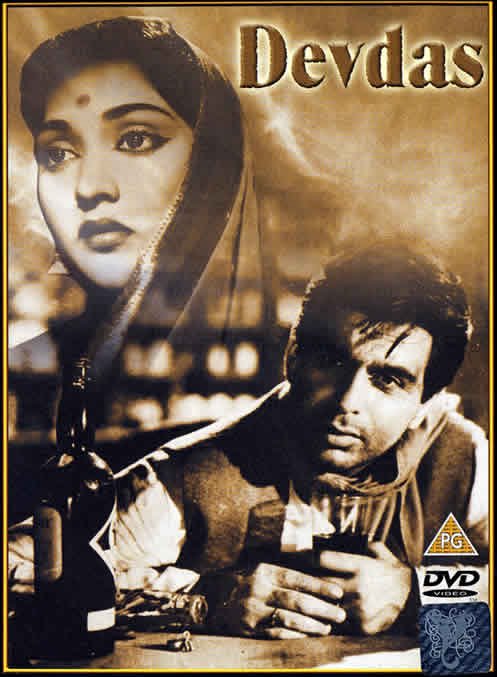
Devdas 1955 vs Devdas 2002

After seeing the 2002 remake of Devdas, I wanted to see the 1955 black and white version.

I have a lot to say about Devdas, the 1955 version and the 2002 remake.

To gain a better understanding, it's always better to watch a film more than once. Contrary to Dilip Kumar’s adversity to making comparisons, I find sometimes comparisons can add a depth of understanding to a story. Comparisons can also enhance appreciation of an art form.

The 1955 Version


http://www.uiowa.edu/~incinema/DEVDAS.htm

The 1955 Devdas was in black and white starring Dilip Kumar, Suchitra Sen, and Vaija Yantimala. The 2002 remake was in color starring Shah Rukh Khan, Aishwarya Rai and Madhuri Dixit.

Most of the Indian movies I had watched previously were shot in the 1990s or 2000s with the exception of the 1970s Bobby, and Mother India, so I was surprised at the rural setting and the bare staging of the 1955 version. The remake was considered the most lavish Indian film to date.

The 1955 movie spent more time desccribing the youthful relationship between Devdas and his childhood friend, Paro. You get more of a sense of separation. The two families, Devdas's and Paro's are neighbors but come from different castes. So, early on it is established that the relationship is fated for failure.

In the 1955 version, you see Devdas and Paro as young children. Devdas is a rascal. He is always getting into trouble. Paro is his faithful playmate. Eventually, his parents send him to Kolkata to stay with an Uncle hoping he will settle down and study.

When Devdas returns home after his long absence, he assumes he can resume his relationship with Paro but the politics of his family intrude. A battle over money is one source of the conflicts.

The expression of emotions in Indian films is both constrained and bold. So, the meetings between Paro and Devdas are brief. While little is said enough is conveyed to communicate that Devdas and Paro are in love.

At first, they thought their parents would agree to their marriage, but both fathers had reasons to object. Devdas’s father objected because Paro’s family was of a lower caste. Paro’s father objected because he felt dishonor in approaching Devdas’s family regarding Paro’s marriage and felt he could find her a richer husband.

When Devdas returns, he seems more subdued, more introspective. Yet, when he is confronted with the conflicts that arise from the prospect of marrying Paro, he is torn. He wants to please his parents, but he also wants to marry Paro. When he cannot resolve the conflict, he returns to Kolkata with the idea he will forget Paro and she him.

In the meantime, Paro is betrothed to another man. The rest of the movie deals with Devdas’s inability to forget Paro and Paro’s acceptance of her fate.

A friend, Chunni, introduces Devdas to Chandramukhi (Vaija Yantimala), a courtesan in a brothel. Devdas expresses distain for her. But, she falls in love with him. Eventually, he begins to drink.

Even though Paro has married, she carries Devdas in her heart. Her approach is more practical and more accepting of her fate. But, her plight illustrates that she yearns for a life with her love.

Chandramukhi seeks to find out where Devdas is and how he is. He visits her now and then and sometimes when he is under the weather. Under the influence of her love for Devdas, Chandramukhi changes her lifestyle and gives up prostitution. In contrast, Devdas adopts self-destructive behaviors.

While there were songs dispersed throughout, only Chandramukhi’s character dances.

Eventually Devdas ruins his health. Chandramukhi has found him in the streets, drunk. She brings him home to care for him. After Devdas recovers he professes a love for Chandramukhi. But, he also feels a need to travel, to find himself. During the trip, a friend encourages him to drink. He becomes ill. He feels close to death, so he finds a carriage and driver to take him to Paro’s home one last time. He had promised Paro he would come to her door when he was in need.

In the 1955 version, the other characters, family and friends, are not well-developed. Their relationships are hinted at—such as Devdas’s conflicts with his brother and sister-in-law.

When I watched the 1955 version again, I enjoyed the movie much more; I was able to focus on the emotional struggles of Paro and Devdas. I felt many could identify with Devdas’s predicament. Also, I felt that the emotional struggle was heroic in some ways.

The movie explores in my mind how a person is affected by the web of relationships in their life and how many aspects of one’s life are decided by others, which is what makes the movie universal.

Dilip Kumar won “Best Actor” and Vyjayanthimala won “Best Supporting Actress” for the 1955 version. The character Devdas and his story have had a wide effect on Indian cinema and culture. The 1917 story of Devdas has been made into film nine times. “Every Indian grew up sensitized to the saga of Devdas.” (Barrow and Krishnaswamy, Indian Cinema) Many Hindi film characters have been modeled after Devdas.

Dilip Kumar distances himself from the Devdas character, for him it was just another role. He did not always agree with the characterization of Devdas especially when Devdas struck Paro. (http://www.rediff.com/entertai/2002/jul/03dilip.htm)

The 2002 Remake

In the 2002 remake, Shah Rukh Khan plays Devdas and Aishwarya Rai plays Paro. The remake is considered the most lavish Indian film to date. Here the neighboring families of Devdas and Paro live in elaborate mansions filled with stain glass windows, painted floors, and works of art. The costumes are colorful and rich.

The movie opens with Devdas’s family preparing to celebrate Devdas’s return; references are made to childhood events throughout the movie.

In interviews about Devdas, Shah Rukh Khan explains that he saw the Devdas character as weak and played him as such.

Many of the characters and their relationships are well developed. Devdas’s and Paro’s mothers play a big role in the story. Devdas’s brother and sister-in-law are seen as weak and scheming, respectively.

There are songs and dances in the remake featuring many lavish numbers. Maduri Dixit shines in her role of Chandramukhi. Her dancing is superb.

The remake stays true to the story in many ways keeping most key scenes such as:

Paro hides from Devdas upon his arrival
Paro and Devdas meeting at the water’s edge
The conflicts over caste and money
Paro and Devdas believe they would be able to marry
Devdas striking Paro
The meeting of Pavarti and her new step-daughter and gift of jewelry
The ending

In the movie, all three characters, Devdas, Paro, and Chandramukhi love and believe in a love that transcends self.

Most scenes are more elaborate than the 1995 version, such as

--when Devdas visits Paro after his return. She has run away into her room. He follows. She hears his steps and lights a wall lamp. He enters as the light casts a glow on Paro’s face. In the remake, the lamp has come to represent Paro’s undying love as she has kept a lamp lit for Devdas since he left.


http://www.revistacinefagia.com/cineditos019.htm

--Paro’s nighttime venture to Devdas to see if he is committed to their relationship. In both the 1955 version and the remake, Paro and Devdas discuss her possible dishonor and how to view their parent’s objections. In the 1955 version, it is a simple scene. In the remake, the language is more frank. Plus, Devdas’s father confronts Paro and calls her and her mother indelicate names. Paro’s mother lectures Paro on family honor.

Both films have Devdas back in Kolkata after the conflict has driven him away. He writes to Paro to persuade her that they should consider themselves friends.

In both films, Paro is engaged and Devdas returns during the ceremonies. When he and Paro meet, he tells Paro that he was wrong to send the letter and that he loves Paro. Paro by this time has accepted the fact that Devdas will not take any action to bring about their marriage, so they have cross words. Devdas responds by striking Paro, leaving a wound on her forehead.

For me this was the turning point in the film, it is Devdas’s admission of failure and his weaknesses.

In the remake, the scene is more poignant because after striking Paro, Devdas leads her to her wedding procession and later carries her bridal litter as she heads towards her new home. After her marriage ceremony, Paro goes to meet Devdas once more. Both Shah Rukh Khan and Dilip Kumar play these scenes with a mixture of pain, meanness, and sadness expressing the unbearableness of the situation.

The wound becomes a symbol of ownership which Paro takes pride in.
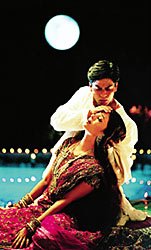

http://www.time.com/time/asia/magazine/article/0,13673,501020610-257165,00.html

In the 1955 version, Paro and Chandramukhi are aware of each other, but they only pass on the road. In the remake, they befriend each other.

In both films, a friend of Devdas’s leads him to a local brothel to help him forget his troubles. Jackie Shroff in the remake gives an excellent performance as the friend, Chunni.

The dialogue in the remake is fuller with more illusionary references.

The difference in brothel settings is striking. In the 1955 version, Chandramukhi’s outfits are simple and she dances alone in a small room in a boarding house. In the remake, Chandramukhi lives in a lavish temple-like dwelling and dances with over eight other dancers. Her outfits are embroidered with gold and jewels and she wears a wealth of bracelets, necklaces, earrings and anklets.

In the remake, Devdas’ gradual deterioration is played out in many painful scenes. Whereas in the 1955 version a few scenes illustrate his decline but leave the viewer to imagine the details.

In the remake, many enjoy Devdas’s predicament, as if he got his comeuppance. But, the characters that take pleasure in bringing Devdas pain are not happy either and while their plans succeed in eliminating Devdas, their goal was power and resources not happiness.

In a sense, Devdas’s life questioned the concept of happiness. What makes one happy?

Within the confines of social conventions, Paro and others still try to save Devdas. Anyone who has had a family member or friend struggle with alcohol the scenes are realistic and the feeling of helplessness is true.

Devdas was a lucky man to be loved by two women. As Chandramukhi says, “Loving isn’t always about receiving. Love is a mirror in the soul. Amour god’s gift to life’s design”


http://www.filmfestivals.com/filmweb/devdas/02.jpg

What is also portrayed in the movie is the idea that Devdas has character, that he is worthy of love even though he has no direction in life and he is indecisive. For some it may seem odd that women would love a man like Devdas but again, I think the scenario is realistic in that few of us are heroic 100% of the time, some struggle with indecision often, and often we find ourselves in situations that are restrictive, where we are asked to subjugate our needs and wants for the sake of family or society. Family and society are not always right when it comes to determining what is good for each human being. It raises the questions, when is sacrifice good, when is it bad?

In another sense, the movie is about spirit and soul, which are not fed by wealth or position but by compassion, love, forgiveness, joy, humility, and charity. But the film implies that those who seek a soulful happiness don’t stand much of a chance. The movie also implies that those in power will seek to cast out those who do not abide by their rules or those whom they deem imperfect. In essence, those in power have the power of life and death. Yet, those cast out have the power to love.

I could identify with Devdas and his relationships with his family and his society. His mother, who claimed to love him, was blind to his true feelings and character. She allowed others to influence her perspectives. This is so true, it seems that many people are easily influenced by others to believe the worst about someone they know or barely know without question. The film also portrays to my mind that the struggle to be a good person is made more difficult by examples of those who are rewarded for bad behavior and evil deeds. When the sister-in-law does not suffer for her lies and schemes, it communicates that being evil is ok. Devdas and Paro are punished for their love.

Because Devdas does not take the route others take when faced with conflict or loss of a love, he is labeled weak. But, in one sense he is honoring his love by choosing to dwell on his situation. His father chooses people by their place in the caste system. His mother sees mercenary goals in others but is blind to her daugher-in-law's schemes and lies. Paro's mother is the only character who is fully aware of Paro and Devdas's feelings. She is sympathetic but when she is scorned by Devdas's family, she arranges a marriage for Paro because honor is more important than love. Chunni is casual about all relationships. Devdas' brother and sister-in-law are too shallow to exhibit any noble feelings, having money is their only value. Chandramukhi whose life has made her almost immune to love falls deeply in love and makes many scarifices to help Devdas. While Devdas loves Paro, in his confusion and conflict he sinks into a depression that curtails any useful decision-making that could help him. None of these scenarios bode well for love.

The underlying feudal power structure of Indian society is reflected in the film. Marriages are arranged to enhance familial power bases and wealth. Households while inter-generational also require a lot of servants drawn from surrounding villages illustrating a divide between the rich and the poor. Emotions are then defined along caste lines. Love and sympathy are given miserly and usually only to their own. For me the scene where Devdas is lying outside Paro’s new home dying and no one from the manor comes to help him expresses a power structure that says we only help our own, the rest are left to their own devices. This does not mean Indian society is unique in this way; all societies practice some kind of hierarchy.

When Chandramukhi stands up to the selfish aristocrat’s son claiming that brothels exist because of aristocrats’ behavior and values, her assessment was a clear indictment of any society that creates a pool of citizens who are deemed less than human or less worthy of respect for the benefit of those in power.

We all must make judgements on many levels when we choose to befriend or love someone, but that does not give license to disrespect those we don't choose.


(c) 2004 CanaryPress Co.